


SAP & Oracle partner and support companies

Loading

Corporate Training in SAP
SAP

How Corporate Training in SAP Saves You Time & Money

In today’s fast-paced digital economy, time and money are two resources that businesses can’t afford to waste. Every second counts, and every dollar invested must bring measurable returns. This is why more and more organizations are turning to corporate training in SAP—a strategy that not only equips employees with cutting-edge skills but also reduces inefficiencies and boosts long-term profitability.

If you’re a business owner, a team leader, or even an employee looking to grow, understanding how SAP corporate training can transform your workplace is a game-changer. Let’s explore how this training helps save time, cut costs, and future-proof your career.

What is SAP and Why Does it Matter?

SAP (Systems, Applications, and Products) is one of the world’s leading enterprise software systems, used by thousands of companies worldwide to manage operations, finance, human resources, supply chain, and customer relationships.

Think of SAP as the nervous system of a business—it integrates all processes and ensures information flows smoothly. Without SAP knowledge, teams often struggle with fragmented systems, duplicate efforts, and costly errors. Corporate training fills this gap by teaching employees how to maximize SAP tools efficiently.

The Hidden Costs of Not Training Employees

Before diving into how SAP training saves resources, let’s look at the flip side—what happens without it:

  • Time Wasted on Trial and Error: Employees who are not properly trained spend hours figuring out features that could have been learned in minutes through structured training.
  • Errors That Cost Money: Inaccurate financial entries or supply chain mismanagement can cause huge financial losses.
  • Low Productivity: When employees don’t fully understand SAP, they underutilize its potential, leading to inefficiencies.
  • Employee Frustration: Teams often feel overwhelmed and demotivated when they don’t know how to use powerful tools effectively.

How SAP Corporate Training Saves Time

  1. Streamlined Processes
    Training ensures employees understand shortcuts, automation, and best practices, allowing them to complete tasks in minutes instead of hours.
  2. Improved Collaboration
    Since SAP integrates different departments (finance, HR, sales, etc.), employees who are trained can collaborate without delays or miscommunication.
  3. Faster Problem-Solving
    Well-trained staff can troubleshoot issues quickly, reducing downtime and avoiding dependency on external consultants.

How SAP Corporate Training Saves Money

  1. Reduced Dependency on Consultants
    Hiring external consultants every time an issue arises is costly. With trained in-house employees, businesses cut down on these recurring expenses.
  2. Error Prevention = Cost Prevention
    A single mistake in data entry or reporting can cost thousands. Proper training minimizes such risks.
  3. Higher ROI on SAP Investment
    Companies spend heavily on SAP software licenses. Training ensures employees use it to its full potential, maximizing the return on investment.
  4. Employee Retention
    Investing in training shows employees that the company values their growth, leading to higher retention and lower hiring costs.

Real-World Example

Imagine a retail company managing thousands of products. Without SAP training, employees might manually update stock records, wasting hours daily. After corporate training, the same tasks could be automated—freeing up time for strategic work like analyzing sales trends or improving customer service. The result? More productivity, happier customers, and reduced costs.

Market Trends & Industry Insights

  • Growing Demand for SAP Professionals: With businesses worldwide moving toward digital transformation, SAP expertise is more in demand than ever.
  • Shift Toward Cloud-Based SAP Solutions: SAP S/4HANA and cloud-based systems are becoming industry standards. Corporate training helps employees adapt to these new tools.
  • Future-Proofing Careers: Employees trained in SAP enjoy better career opportunities, ensuring long-term financial growth.

Practical Tips for Beginners

  1. Start with Basics: Don’t jump into advanced modules. Begin with core concepts of SAP Finance (FI), Materials Management (MM), or Sales and Distribution (SD).
  2. Use Hands-On Learning: The best way to learn SAP is by practicing in a sandbox system.
  3. Leverage Corporate Workshops: Group training helps teams learn together and solve company-specific challenges.
  4. Track Progress: Companies should regularly assess employees’ skills post-training to ensure knowledge is applied effectively.

Why Your Company Should Invest Now

The longer a business waits to train its workforce, the more time and money it wastes. Whether you’re a startup aiming to scale or an established enterprise striving to optimize, corporate training in SAP is a high-return investment.

Think of it this way: if training saves each employee just one hour per day, across a team of 50 people, that’s 250 hours saved every week. Multiply that by 52 weeks, and the savings become extraordinary—both in productivity and cost.

Final Thoughts

Corporate training in SAP isn’t just about teaching software—it’s about empowering employees, streamlining processes, and ensuring businesses thrive in competitive markets. For employees, it opens doors to better opportunities. For companies, it means fewer mistakes, more efficiency, and greater profits.

If you’re serious about staying ahead, it’s time to take the leap. Start with the basics, build strong foundations, and watch how SAP training transforms your workplace.

👉 Ready to get started? Explore our advanced SAP corporate training programs today and give your career—and your company—the competitive edge it deserves.

YOU MAY LIKE THIS

What is AWS Lambda?A Beginner’s Guide to Serverless Computing in 2025

Java vs. Kotlin: Which One Should You Learn for Backend Development?

Where to Find Your Salesforce Organization ID

How Salesforce Stands Out from Other CRMs

SAP for Business Owners Dashboard Example
SAP

SAP for Business Owners: What You Really Need to Know

Running a successful business today isn’t just about having a great product or service—it’s about how efficiently you manage your people, processes, and finances. This is where SAP (Systems, Applications, and Products in Data Processing) comes into play.

For many business owners and employees, SAP might sound like a complex tech jargon reserved only for IT teams. But the reality is very different. SAP is a powerful business management tool that can help organizations of all sizes streamline operations, improve decision-making, and drive long-term growth.

In this guide, we’ll break down SAP for business owners in simple terms, explore its benefits, and share real-world applications that will help you understand why SAP could be the smartest investment you make for your business future.

What Is SAP in Simple Words?

Think of SAP as a digital nervous system for your business. Just as your body’s nervous system connects different organs, SAP connects various departments—finance, sales, human resources, logistics, customer service—into one central system.

Instead of each department working in isolation with scattered data, SAP ensures that everyone has access to accurate, real-time information. This makes decision-making faster and more reliable.

👉 Example: If a customer places a bulk order, SAP updates inventory levels immediately, alerts the finance department, and even ensures delivery schedules are updated—all in real time.

Why Should Business Owners Care About SAP?

Many business owners assume SAP is only for big corporations. That’s a myth. In today’s digital economy, even small and medium-sized enterprises (SMEs) are adopting SAP solutions to stay competitive. Here’s why it matters:

  1. Efficiency at Scale
    SAP automates routine tasks like invoicing, payroll, and reporting—saving time and reducing errors.
  2. Data-Driven Decisions
    With real-time insights, you can spot market trends, monitor performance, and respond to changes faster than competitors.
  3. Cost Control
    SAP highlights inefficiencies and hidden costs, helping you reduce waste and improve profitability.
  4. Customer Satisfaction
    From faster order fulfillment to better customer support, SAP ensures your clients enjoy a seamless experience.
  5. Future-Readiness
    As your business grows, SAP grows with you—offering advanced tools like AI, analytics, and cloud integration.
    Key SAP Modules Every Business Owner Should Know

You don’t need to master every SAP module, but understanding the basics can help you make better investment decisions.

  • SAP FI (Financial Accounting): Manages financial transactions, reporting, and compliance.
  • SAP SD (Sales & Distribution): Handles order processing, pricing, and delivery.
  • SAP MM (Materials Management): Manages procurement, inventory, and vendor relationships.
  • SAP HR/HCM (Human Capital Management): Streamlines recruitment, payroll, and employee performance tracking.
  • SAP CRM (Customer Relationship Management): Enhances customer engagement and loyalty.

Real-World Applications of SAP for Business Owners

To make this practical, let’s look at how SAP impacts businesses across industries:

  • Retail: A fashion store can track best-selling items, forecast demand, and avoid overstocking.
  • Manufacturing: A factory can optimize supply chains, reduce downtime, and ensure quality control.
  • Healthcare: Hospitals use SAP to manage patient records, staff schedules, and billing systems.
  • Finance: Banks leverage SAP to comply with regulations while offering personalized services.

These examples show that SAP is not just software—it’s a business transformation tool.

Industry Insights and Market Trends

The SAP market is evolving rapidly. According to industry reports, the global ERP market (where SAP leads) is projected to grow steadily over the next decade. Businesses are moving toward cloud-based SAP solutions for flexibility and scalability.

👉 Trend to Watch: SAP S/4HANA, the latest generation ERP, is becoming the gold standard for digital businesses. If you’re planning long-term growth, this is where you should focus.

Tips for Business Owners Starting with SAP

If you’re considering SAP for the first time, here are some beginner-friendly tips:

  1. Start Small, Scale Later – Begin with core modules like SAP FI or SAP SD before exploring advanced ones.
  2. Involve Employees Early – Train your staff to use SAP effectively. Their support will determine success.
  3. Choose Cloud-Based Solutions – For SMEs, cloud-based SAP is cost-effective and easier to implement.
  4. Partner with Experts – Work with certified SAP consultants or training providers to avoid common pitfalls.
  5. Keep Learning – SAP is constantly evolving. Regular training ensures you stay ahead of the curve.

Taking the First Step Toward Business Transformation

At its core, SAP is about empowering business owners to run smarter, faster, and more profitably. Whether you’re leading a startup or managing a growing enterprise, understanding SAP can give you the confidence to make better decisions and prepare for the future.

Remember, the first step is always the hardest—but also the most rewarding. By investing in learning SAP fundamentals, you’re not just upgrading your business operations—you’re investing in long-term success.

Call-to-Action

🚀 Ready to explore SAP in more depth? Our website offers specialized courses and resources designed for business owners and employees who want to master SAP. Start your journey today, and turn your business vision into reality with the power of SAP.

👉 [Explore SAP Courses on Our Website]

Start Learning Now

What is AWS Lambda?A Beginner’s Guide to Serverless Computing in 2025

Java vs. Kotlin: Which One Should You Learn for Backend Development?

Where to Find Your Salesforce Organization ID

How Salesforce Stands Out from Other CRMs

SAP Consultant working on enterprise systems
SAP

A Day in the Life of a SAP Consultant: What to Expect & Why It Matters

If you’ve ever wondered what it’s like to walk in the shoes of an SAP Consultant, you’re in the right place.

Whether you’re a curious professional looking to transition into tech, an employee trying to understand how SAP impacts your company, or a beginner aiming to kickstart a financially rewarding career—this post is for you.

Let’s dive into a day in the life of an SAP Consultant and explore what makes this role both exciting and essential in today’s digital business landscape.

🧩 What is an SAP Consultant?

First things first—SAP stands for Systems, Applications, and Products in Data Processing. It’s one of the world’s leading enterprise resource planning (ERP) software systems, used by companies to streamline business operations like finance, logistics, sales, HR, and more.

An SAP Consultant is a professional who helps companies implement, customize, and optimize SAP systems to fit their business needs. Think of them as the bridge between business and technology.

There are different types of SAP Consultants, such as:

  • Functional Consultants – specialize in business processes (e.g., finance, supply chain).
  • Technical Consultants – focus on coding, integration, and development.
  • Basis Consultants – manage the system architecture and performance.

🌅 Morning Routine: Client Check-Ins & Project Planning

A typical day for an SAP Consultant starts with reviewing emails and updates from client teams, project managers, or internal stakeholders. If you’re working in a global company, time zones matter. Morning hours are often dedicated to syncing with international teams.

Daily stand-ups or planning meetings may cover:

  • Project milestones
  • Technical challenges
  • Business requirements
  • Client feedback

Pro Tip: Staying organized with tools like SAP Solution Manager, Jira, or Microsoft Teams can help keep projects on track and stress levels low.

🧠 Mid-Morning: Solving Real-World Business Problems

Once the planning is done, it’s time to dive into the real work.

  • A Functional SAP Consultant might configure the SAP S/4HANA Finance module to improve a company’s reporting accuracy.
  • A Technical Consultant could be writing ABAP (Advanced Business Application Programming) code to automate invoice generation.
  • A Basis Consultant might be optimizing the SAP HANA database for faster performance.

This is where the magic happens—translating business pain points into digital solutions.

“Every day brings a new challenge, and that’s what keeps the role exciting,” says Priya, a Senior SAP Consultant with 7 years of experience. “You’re not just fixing problems—you’re helping businesses evolve.”

🥗 Lunch Break: Networking & Upskilling

SAP Consultants often use lunchtime to connect with colleagues or continue learning. The SAP ecosystem is constantly evolving, and staying updated is crucial.

Many consultants:

  • Attend virtual SAP Learning Hub sessions
  • Earn certifications like SAP S/4HANA Certified Application Associate
  • Read SAP blogs or case studies to understand industry trends

Remember, the best SAP consultants are lifelong learners.

🔧 Afternoon: Client Workshops & Testing

In the afternoon, you might run a client workshop to demonstrate how a new system works or gather more requirements. These workshops are collaborative and help clients feel involved in the implementation process.

Then it’s time for testing:

  • Unit Testing: Does the function work as intended?
  • Integration Testing: Does it work with other modules?
  • User Acceptance Testing (UAT): Does the client approve?

A successful SAP Consultant balances technical know-how, business understanding, and communication skills.

📝 Late Afternoon: Documentation & Reporting

No project is complete without proper documentation. An SAP Consultant wraps up the day by updating configuration guides, creating user manuals, or writing status reports for clients and project managers.

Good documentation ensures:

  • Smooth handovers
  • Easier troubleshooting
  • Regulatory compliance

🔮 Industry Trends: Why SAP Skills Are in Demand

The global SAP market is booming, with companies investing in digital transformation at an unprecedented pace. According to IDC, the SAP ecosystem is expected to generate $200+ billion in revenue by 2027.

Industries leading the demand:

  • Manufacturing
  • Retail
  • Healthcare
  • Finance
  • Logistics

If you’re looking for job security, growth potential, and global opportunities, SAP consulting is a career path worth exploring.

💡 How to Get Started as a Beginner

Here are practical tips if you’re considering a career as an SAP Consultant:

  1. Choose a module: Start with what interests you—Finance (FI), Sales (SD), Materials Management (MM), or HR (HCM).
  2. Take beginner courses: Start with foundational SAP training. Many platforms, including [Our Website], offer beginner to expert-level courses.
  3. Earn certifications: SAP Certified Application Associate credentials are well recognized.
  4. Practice in sandbox systems: Hands-on practice is critical to success.
  5. Build soft skills: Communication, problem-solving, and adaptability are just as important as technical skills.

🚀 Final Thoughts: Your Future in SAP Starts Now

A day in the life of an SAP Consultant is diverse, dynamic, and deeply impactful. You get to solve real business problems, work with cutting-edge technology, and shape the digital future of global organizations.

Whether you’re a student, a career changer, or a professional seeking to upskill—this could be your gateway to financial independence and global opportunities.

🎯 Ready to Take the First Step?

Explore our SAP Learning Pathway tailored for beginners. Learn at your own pace, earn industry-recognized certifications, and take control of your future.

👉 Start Learning Now

What is AWS Lambda?A Beginner’s Guide to Serverless Computing in 2025

Java vs. Kotlin: Which One Should You Learn for Backend Development?
Where to Find Your Salesforce Organization ID

How Salesforce Stands Out from Other CRMs

SAP ABAP vs. FICO vs. MM comparison infographic
SAP

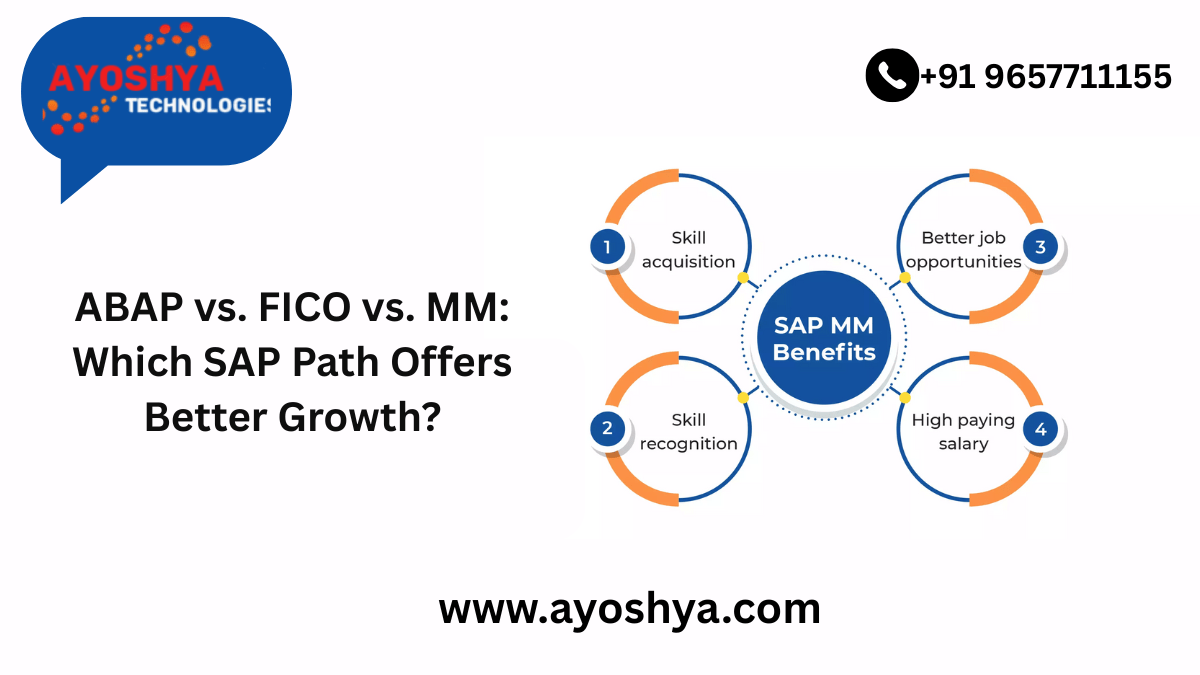
ABAP vs. FICO vs. MM: Which SAP Path Offers Better Growth?

Are you considering a career in SAP but confused between ABAP, FICO, and MM? You’re not alone. Whether you’re a fresh graduate, an IT professional exploring SAP, or a company employee looking to upskill, this blog will help you understand the core differences between these three popular SAP domains—and more importantly, which one could lead you to long-term success.

Let’s break down what each of these SAP paths is all about and explore which one might offer better growth for your unique goals.

🔍 Understanding the Basics: What Are ABAP, FICO, and MM?

Before we dive into growth opportunities, let’s get clear on what each of these terms means:

1. ABAP (Advanced Business Application Programming)

ABAP is SAP’s proprietary programming language. It’s used to develop custom reports, interfaces, forms, and enhancements inside the SAP system. If you love coding, solving logic problems, and creating software solutions, ABAP is your playground.

Ideal For: Developers, Computer Science graduates, tech-savvy professionals.

2. FICO (Financial Accounting and Controlling)

FICO is SAP’s financial module, essential for handling accounting, reporting, budgeting, and internal cost control. It helps organizations manage their financial operations effectively and is used across nearly every industry.

Ideal For: Finance graduates, accountants, and professionals with a background in business or economics.


3. MM (Materials Management)

MM deals with procurement, inventory management, and material planning. It connects departments like logistics, purchasing, and warehousing and is crucial for supply chain operations.

Ideal For: Supply chain professionals, procurement specialists, and those interested in logistics or operations management.

📈 Career Growth: Which Path Has the Edge?

Each module has its own strengths and market demand. Here’s how they stack up:

🚀 1. ABAP: High Demand, Especially with S/4HANA

With SAP transitioning to S/4HANA, ABAP developers with HANA skills are in hot demand. The role offers solid pay and technical growth. However, it can be more saturated since many choose ABAP as a starting point.

💡 Pro Tip: Learn Fiori, CDS Views, and HANA programming to stay ahead in ABAP.

💰 2. FICO: Evergreen Demand in Finance

Every company needs finance professionals, and SAP FICO consultants are always in demand. As financial regulations and analytics become more complex, FICO experts with domain knowledge stand out.

💡 Pro Tip: Combine FICO with SAP Analytics Cloud or Central Finance to future-proof your career.

🏭 3. MM: Core of Supply Chain & Procurement

With global supply chains becoming increasingly digital, MM professionals play a vital role. MM is often underestimated but has high strategic value, especially when integrated with SAP Ariba and S/4HANA Logistics.

💡 Pro Tip: Learn integration with SD (Sales & Distribution) and PP (Production Planning) for a full-stack SCM profile.

🌍 Industry Insights & Real-World Applications

Let’s look at how these modules play out in real companies:

  • A global FMCG brand uses FICO to track every cent of spend across 80 countries.
  • A multinational automotive company runs MM to manage thousands of suppliers and spare parts daily.
  • A tech startup relies on ABAP developers to build custom dashboards and automate internal reports.

In short, no matter which module you choose, there’s a real-world application for it across industries—banking, manufacturing, healthcare, retail, and more.

🙌 Which One Should You Choose?

Here’s a quick cheat sheet to help:

You Are…Best Fit
A coding enthusiastABAP
From a finance/accounting backgroundFICO
Experienced in supply chain/procurementMM
Looking for long-term consulting careerFICO/MM
Passionate about technology and customizationABAP

🔧 Practical Tips to Get Started

  • Start with Free Resources: Explore beginner tutorials on YouTube or open SAP learning platforms.
  • Join SAP Communities: Forums like SAP Community or LinkedIn groups can help you stay updated.
  • Try Mini Projects: Practice on SAP Learning Hub or trial systems if you can access them.
  • Earn Certifications: SAP official certifications in ABAP, FICO, or MM boost your credibility.
  • Stay Curious: SAP is evolving—keep learning about AI, cloud, and integration modules.

🌟 Final Thoughts: It’s Not Just About Growth, But Fit

In the end, the best path for you isn’t just about what pays more or is more in demand—it’s about what fits your interests, skills, and career goals.

Remember, success in SAP isn’t a sprint—it’s a marathon. What matters is getting started. Whether you pick ABAP, FICO, or MM, you’re stepping into a globally respected technology ecosystem with massive opportunities.

🚀 Ready to Take the Next Step?Explore beginner to advanced SAP courses tailored to your career path on [YourWebsiteName.com]. Our certified trainers and hands-on learning modules will give you the skills and confidence to grow fast in your SAP journey.

Top Skills Required to Excel as a SAP MM Consultant

Building Client Relationships: From Technical Expert to Trusted Advisor

Simplified Business WoYOU MAY LIKE THIS

Top Skills Required to Excel as a SAP MM Consultant

Building Client Relationships: From Technical Expert to Trusted Advisor

Simplified Business Workplace – Workflow Inbox in SAP R/3rkplace – Workflow Inbox in SAP R/3

SAP ABAP vs. FICO vs. MM career comparison infographic
SAP

ABAP vs. FICO vs. MM: Which Path Offers Better Growth?

Whether you’re just stepping into the world of SAP or considering a shift in your career path, the choices can be overwhelming. ABAP, FICO, and MM are three core modules in the SAP ecosystem—but which one offers the best growth? More importantly, which is right for you ?

Let’s break down each path, explore their career potential, and help you make an informed, confident decision.

What is SAP, and Why Does It Matter?

SAP (Systems, Applications, and Products in Data Processing) is a global leader in enterprise software. It helps businesses manage operations, finance, supply chains, and more. Companies across industries—from banking and retail to manufacturing and pharmaceuticals—use SAP.

That means there’s a massive demand for professionals skilled in SAP tools. But what makes ABAP, FICO, and MM stand out?

Understanding the Three SAP Pillars

1. ABAP (Advanced Business Application Programming)

What it is: ABAP is SAP’s programming language. It’s used to develop custom reports, interfaces, and enhancements for SAP systems.

Who it’s for: Tech-savvy individuals, developers, or those who love solving problems with code.

Key Skills:

  • Programming logic
  • SAP architecture understanding
  • Object-oriented programming (OOP)

Real-World Example: Imagine a company needs a customized payroll report. An ABAP developer writes the code that tailors SAP to meet that specific need.

Career Growth Insight: With the rise of SAP S/4HANA and cloud adoption, ABAP developers now need to adapt to ABAP on HANA and SAP Fiori UI technologies. So there’s strong growth if you stay updated.

2. FICO (Financial Accounting and Controlling)

What it is: FICO is the financial brain of SAP. It covers everything from managing ledgers and invoices to cost control and financial planning.

Who it’s for: People with a background or interest in finance, accounting, or business analysis.

Key Skills:

  • Financial principles and reporting
  • SAP financial configuration
  • Analytical thinking

Real-World Example: A multinational firm needs to consolidate accounts across global branches. FICO consultants help streamline this process, ensuring compliance and transparency.

Career Growth Insight: FICO roles are evergreen—every company needs financial management. With SAP S/4HANA Finance, demand for FICO professionals with modern skills is booming.

3. MM (Materials Management)

What it is: MM handles procurement and inventory management—think supply chains, purchase orders, and warehouse data.

Who it’s for: People interested in logistics, procurement, or operations management.

Key Skills:

  • Supply chain concepts
  • Vendor management
  • Inventory optimization

Real-World Example: A retail giant needs to manage stock across 100+ stores. MM consultants configure SAP to automate stock levels, reorder points, and vendor tracking.

Career Growth Insight: With global supply chains becoming more complex, companies rely on MM professionals to keep operations smooth and cost-effective. It’s a high-demand field with solid long-term growth.

Which SAP Path Offers the Best Growth?

Here’s the thing—each path offers great opportunities, but your growth depends on your strengths and goals.

ModuleBest ForCareer PathDemand Trend
ABAPDevelopers, codersSAP Developer, Technical ConsultantGrowing with SAP S/4HANA and cloud
FICOFinance professionalsSAP FICO Consultant, Financial AnalystStable with digital finance growth
MMLogistics & supply chain fansSAP MM Consultant, Procurement LeadRising with supply chain digitization

So, the question isn’t just “Which has more growth?” but “Which suits you the best?”

Tips for Choosing the Right Path

  1. Assess Your Interests:
    • Love coding? Go ABAP.
    • Into finance? FICO’s your friend.
    • Curious about logistics? MM is the way to go.
  2. Check Your Background:
    • Coming from a commerce/finance background? FICO.
    • Engineering or IT? ABAP could be ideal.
    • Experience in supply chains or retail? MM fits well.
  3. Explore the Market:
    • Use job portals like LinkedIn, Naukri, or Glassdoor to see which roles are in demand in your region.
  4. Start Small, Then Specialize:
    • Many professionals start with one module and expand into others. For example, MM + SD (Sales & Distribution), or ABAP + Fiori.

Real-Life Success Stories

Meet Anjali, a commerce graduate who started with SAP FICO. Within 3 years, she became a lead consultant working on global finance transformation projects.

Then there’s Ravi, a computer science engineer. He began with ABAP, learned SAP UI5 and Fiori, and now builds cloud-based SAP solutions.

Both paths—technical and functional—can be fulfilling. The key? Start. Learn. Grow.

Ready to Take the First Step?

If you’re serious about building a future-proof career, SAP is a fantastic space to be in. Whether you choose ABAP, FICO, or MM, there’s no wrong answer—just a path waiting for you to walk it.

🚀 Explore Beginner-to-Advanced SAP Courses on Our Platform!

Our expert-curated learning paths help you master SAP skills with:

  • Real-time projects
  • Certification guidance
  • Career mentorship

👉 Click here to start your SAP journey today!

Final Thoughts

Choosing between ABAP, FICO, and MM isn’t about picking the “best” one. It’s about picking what’s best for you. Each module offers long-term growth, solid salaries, and the chance to work with leading global companies.

Start with your strengths, keep learning, and you’ll find your SAP success story.

YOU MAY LIKE THIS

Top Skills Required to Excel as a SAP MM Consultant

Building Client Relationships: From Technical Expert to Trusted Advisor

Simplified Business Workplace – Workflow Inbox in SAP R/3

SAP Modules overview chart
SAP

Different SAP Modules Explained: Which One Suits You?

Are you just getting started with SAP and feeling overwhelmed by all the different modules? You’re not alone. SAP is a powerful system used by companies around the world—but with dozens of modules out there, it can be tough to know where to begin.

Whether you’re an aspiring professional looking to enter the world of enterprise software or an employee seeking to upskill, understanding SAP modules is a smart first step. Let’s break it all down in plain English, explore how these modules fit into the real world, and help you decide which one could be your perfect match.

What is SAP, and Why Does It Matter?

SAP (Systems, Applications, and Products in Data Processing) is a leading ERP (Enterprise Resource Planning) software used by organizations to manage business operations and customer relations. Think of it as the digital backbone of a company—helping departments like finance, logistics, HR, and sales work together efficiently.

In today’s data-driven world, companies need scalable systems that unify processes and streamline operations. That’s where SAP shines—and why skilled SAP professionals are in high demand globally.

Why Are There So Many SAP Modules?

SAP is designed to support different functions within a business. Each module focuses on a specific area, making it easier for companies to customize SAP to their needs.

Here’s a beginner-friendly overview of the most popular SAP modules and what they’re used for.

1. SAP FI (Financial Accounting)

Best for: Finance professionals, accountants, auditors

This module helps businesses manage their financial data, track assets, monitor expenditures, and comply with regulations.

Real-world example: A multinational corporation uses SAP FI to consolidate its global financial reports, making year-end audits faster and more accurate.

Career tip: If you’re already in accounting or finance, learning SAP FI can give your resume a serious boost.

2. SAP CO (Controlling)

Best for: Budget analysts, finance planners, cost controllers

SAP CO works hand-in-hand with SAP FI to help companies control costs and plan budgets.

Real-world application: A manufacturing company uses SAP CO to analyze production costs and optimize resource allocation.

Quick tip: CO is a great complement to FI if you enjoy data analysis and financial planning.

3. SAP MM (Materials Management)

Best for: Procurement specialists, inventory managers, logistics roles

This module is all about managing materials, purchasing, and inventory.

Example: A retail chain uses SAP MM to streamline stock management across all its locations, reducing waste and improving delivery times.

Motivational tip: If you love working with logistics or supply chains, this is your entry point into SAP.

4. SAP SD (Sales and Distribution)

Best for: Sales professionals, customer service agents, order fulfillment roles

SAP SD handles everything from order processing to shipping and billing.

Industry insight: E-commerce companies use SAP SD to manage high-volume sales transactions and ensure timely deliveries.

Why it matters: In a digital sales-driven world, this module is key to customer satisfaction.

5. SAP HCM (Human Capital Management)

Best for: HR professionals, recruiters, payroll managers

This module helps manage employee information, payroll, recruitment, and more.

Relatable scenario: A growing startup implements SAP HCM to automate hiring and payroll processes, freeing up HR to focus on people—not paperwork.

Career direction: If you’re in HR or considering a pivot into it, HCM is a great way to digitize your skill set.

6. SAP PP (Production Planning)

Best for: Manufacturing engineers, production planners

SAP PP helps in planning and managing manufacturing processes efficiently.

Example: A car manufacturer uses SAP PP to streamline production schedules, reduce downtime, and meet demand faster.

Tip: If you have an engineering or manufacturing background, this module is tailor-made for you.

7. SAP BI/BW (Business Intelligence/Business Warehouse)

Best for: Data analysts, business consultants, IT pros

This module helps with reporting, data analysis, and decision-making.

Real-world use: A marketing team uses SAP BI to track campaign performance and make data-driven strategy changes.

Hot trend: In the age of big data, SAP BI skills are increasingly valuable in every industry.

How to Choose the Right SAP Module for You

Choosing the right module depends on your current job role, career goals, and interests. Here’s a simple decision-making guide:

Your BackgroundRecommended SAP Module
Finance/AccountingSAP FI, SAP CO
HR or RecruitmentSAP HCM
Logistics/Supply ChainSAP MM, SAP SD
ManufacturingSAP PP
Data & AnalyticsSAP BI/BW
SalesSAP SD

Ask yourself:

  • What am I passionate about?
  • Where do I see myself in 5 years?
  • Which industries am I interested in?

Industry Trends: Why SAP is the Future

Here’s what’s exciting: SAP is evolving rapidly. With cloud solutions like SAP S/4HANA, businesses are becoming more agile, real-time, and data-driven.

Major companies like Coca-Cola, BMW, and Nestlé rely on SAP daily. As these systems evolve, so does the demand for skilled SAP professionals across industries—tech, healthcare, retail, logistics, and finance.


Take Your First Step Today

Learning SAP isn’t just for tech wizards—it’s for anyone willing to invest in their future. Many professionals start by learning one module that aligns with their role, then expand over time.

💡 Practical Tips to Get Started:

  • Identify the module that best fits your role
  • Enroll in a beginner-friendly SAP course (we offer a variety!)
  • Practice using free demo systems or simulations
  • Join online forums and SAP communities for real-time support

Ready to Unlock Your Career Potential?

Don’t wait for change—be the change. Whether you’re new to the workforce, switching careers, or just curious, mastering SAP can unlock doors to global opportunities.

👉 Explore our SAP learning resources and beginner courses here. Let’s get started on your success journey today.

YOU MAY LIKE THIS

Top Skills Required to Excel as a SAP MM Consultant

Building Client Relationships: From Technical Expert to Trusted Advisor

Simplified Business Workplace – Workflow Inbox in SAP R/3

Tesla stock price trend using Pandas
SAP

Using Pandas to Analyze Historical Stock Prices: A Beginner’s Guide to Smart Financial Insights

Whether you’re a curious individual just stepping into the world of investing or a company employee looking to make more informed financial decisions, learning to analyze historical stock prices can be a game-changer. And guess what? You don’t need to be a Wall Street analyst to get started. With Pandas, a powerful Python library, you can unlock insights from stock market data like a pro—even if you’re brand new to coding or finance.

In this blog, we’ll break down the fundamentals of using Pandas to analyze historical stock prices, explore market trends, and reveal practical insights that can drive smarter investment decisions. Let’s turn that curiosity into capability!

🧠 Why Analyzing Stock Data Matters

Before diving into the code, it’s important to understand why historical stock price analysis is such a valuable skill:

  • Spot Market Trends: By analyzing price data over time, you can identify patterns like bullish (rising) or bearish (falling) trends.
  • Understand Industry Movements: Comparing companies within an industry can offer insights into which businesses are thriving.
  • Make Data-Driven Decisions: Whether you’re investing, budgeting, or planning company strategies, decisions backed by data are always stronger.

Learning to work with stock price data is a stepping stone to financial literacy—and ultimately, long-term financial success.

🧰 Getting Started with Pandas

Pandas is a Python library designed for data manipulation and analysis. It lets you load, clean, filter, and visualize data efficiently—perfect for working with historical stock data.

To begin, install Pandas (if you haven’t already):

bash

CopyEdit

pip install pandas

You’ll also need NumPy and Matplotlib for enhanced functionality:

bash

CopyEdit

pip install numpy matplotlib

📈 Loading Historical Stock Data

Let’s say you want to analyze Tesla’s stock (TSLA). You can get historical data from sources like Yahoo Finance using the yfinance package.

python

CopyEdit

import pandas as pd

import yfinance as yf

# Load Tesla stock data from 2020 to 2024

tsla = yf.download(‘TSLA’, start=’2020-01-01′, end=’2024-12-31′)

# Display the first few rows

print(tsla.head())

This will give you a table of data with columns like Open, High, Low, Close, Volume, and Adjusted Close.

🔍 Exploring Trends in Stock Prices

Now that we have data, let’s look at how to extract useful insights:

1. Plotting the Closing Price

python

CopyEdit

import matplotlib.pyplot as plt

tsla[‘Close’].plot(title=’Tesla Closing Prices Over Time’, figsize=(12,6))

plt.xlabel(“Date”)

plt.ylabel(“Price (USD)”)

plt.show()

What you’ll learn: This visual shows how the stock performed over time—great for spotting growth trends or market crashes.

2. Calculating Moving Averages

Moving averages smooth out short-term fluctuations and highlight longer-term trends.

python

CopyEdit

tsla[‘MA30’] = tsla[‘Close’].rolling(window=30).mean()

tsla[[‘Close’, ‘MA30′]].plot(title=’30-Day Moving Average of TSLA’, figsize=(12,6))

plt.show()

Real-world tip: Many investors use 30-day and 100-day averages to decide when to buy or sell stocks.

🏭 Comparing Industry Peers

Want to compare Tesla to other companies like Ford (F) or General Motors (GM)? Easy.

python

CopyEdit

tickers = [‘TSLA’, ‘F’, ‘GM’]

data = yf.download(tickers, start=’2020-01-01′, end=’2024-12-31′)[‘Close’]

data.plot(figsize=(14,7), title=”Stock Prices: Tesla vs Ford vs GM”)

plt.show()

What this reveals: Which companies are gaining market share? Who’s underperforming? A quick plot can tell the story.

💡 Beginner-Friendly Tips for Success

  • Start small: Don’t try to analyze 50 stocks at once. Begin with one or two.
  • Use real-world questions: Ask, “How did this company perform during COVID?” or “What happened during the chip shortage?”
  • Automate insights: As you grow, you can automate stock analysis with scripts or even build dashboards!

🚀 From Learner to Analyst: Your Next Step

You’ve just scratched the surface of what Pandas can do for stock analysis. Imagine having the skills to:

  • Spot financial trends before they hit headlines
  • Make smarter investment choices
  • Even build your own stock analysis tool

Whether you’re a curious individual or a company professional, the path to financial empowerment starts here. The good news? You’re not alone on this journey.

👉 Ready to go deeper? Explore our advanced Python for Financial Analysis courses, live workshops, and hands-on projects designed specifically for beginners—available now on our learning platform.

Final Thoughts

Analyzing historical stock prices might sound intimidating at first, but with tools like Pandas and a little curiosity, you’ll find it not only accessible but empowering. Data is the new oil, and learning to refine it is your first step toward financial independence and literacy.

So what are you waiting for? Start analyzing, start learning, and start building your financial future today!

You might be like this:-

What is AWS Lambda?A Beginner’s Guide to Serverless Computing in 2025

Java vs. Kotlin: Which One Should You Learn for Backend Development?

Where to Find Your Salesforce Organization ID

How Salesforce Stands Out from Other CRMs

SAP certification worth it in 2025
SAP

Is SAP Certification Worth It in 2025? Here’s the Reality

  1. Thinking about getting SAP certified in 2025 but unsure if it’s worth the investment?

You’re not alone.

Every year, thousands of aspiring professionals ask the same question: “Is SAP certification really worth it?” With the SAP job market evolving and new technologies like SAP S/4HANA, BTP, and AI integrations emerging, it’s a smart question to ask.

In this blog post, we’ll dive into the real value of SAP certification in today’s market. You’ll learn how it can impact your career, whether you’re just starting out or looking to grow in your current role. We’ll also break down market trends, industry insights, and real-world applications and help you decide whether SAP certification is your ticket to long-term success.


What Is SAP Certification?

SAP certification is a credential awarded by SAP SE that proves your expertise in a specific SAP module or product. There are two main types:

  • Associate Certification—Ideal for beginners.
  • Professional Certification—For those with project experience.

Popular certifications include:

  • SAP S/4HANA Finance (FICO)
  • SAP ABAP
  • SAP MM (Materials Management)
  • SAP SD (Sales and Distribution)
  • SAP BTP (Business Technology Platform)


Is SAP Certification Worth It in 2025?

✅ YES—But with the Right Mindset

Let’s be honest—SAP certification alone won’t land you a six-figure job. But it can be a powerful career accelerator if combined with the right training and project exposure.

Here’s why it’s still valuable in 2025:


1. Industry Demand Is Still High

SAP is not going anywhere. In fact, the global ERP market is expected to exceed $70 billion by 2029, with SAP leading the pack.

Thousands of companies are

  • Migrating to SAP S/4HANA
  • Integrating SAP BTP
  • Expanding their SAP Fiori user experiences

This transformation means more demand for SAP-certified professionals who can help companies innovate.

Pro Tip: Certification signals that you’re serious and technically equipped to contribute to these transformations.


2. Employers Use It as a Benchmark

For hiring managers, SAP certification is an easy way to filter resumes and spot candidates who have formal training.

Example: Two resumes land on a recruiter’s desk. One has “SAP SD certified (S/4HANA),”” while the other doesn’t. Guess which one makes it to the interview pile?


3. Better Job Opportunities and Salary Potential

Certified SAP professionals consistently earn 20–30% higher salaries than their non-certified peers (depending on geography and experience level).

According to recent job portal stats:

  • Entry-level SAP-certified consultants earn ₹6–9 LPA in India.
  • Certified professionals in the US average $90,000–$130,000/year.

While certification isn’t a golden ticket, it helps you negotiate better salaries and positions.


4. Fast-Track Career Growth

In many companies, certification is a requirement for promotion or client-facing roles. It can also open doors to freelance consulting, international placements, and specialized roles (like SAP Fiori UX Designer or SAP BTP Architect).

Motivational Tip: Certification tells your employer (and yourself) that you’re ready for the next level.


5. Access to SAP Learning Hub and Global Network

Getting SAP certified gives you access to:

  • SAP Learning Hub resources
  • Certification badges recognized worldwide
  • SAP Community where you can connect with mentors and professionals

You’re not just learning SAP—you’re joining a global network of ERP experts.


What Certification Alone Won’t Do

It’s important to set realistic expectations. Certification alone:

  • Won’t replace hands-on experience
  • Won’t guarantee a job without real project training
  • Won’t teach you soft skills like client communication or documentation

That’s why at Ayoshya, we combine SAP certification guidance with real-project training, mentor support, and job-readiness programs.


Who Should Consider SAP Certification in 2025?

1. Freshers or Career Changers
If you’re from a finance, supply chain, or IT background and want to enter the ERP world, certification can give you the technical foundation to get noticed.

2. Working Professionals
Upskilling with SAP certification can help you shift into more strategic roles or explore remote/freelance opportunities.

3. Entrepreneurs and Consultants
Understanding SAP helps you support clients better, optimize operations, or even start your own consulting firm.


Real-World Success Story

Meet Arjun, a mechanical engineering graduate who was struggling to land a job. He took a 4-month SAP MM certification course with real-time training through Ayoshya. Today, he works as an SAP Associate Consultant for a leading logistics company.

“Without the hands-on projects and mentorship, I would’ve just had a certificate. But with both, I had confidence—and a job offer.”


How to Get Started (The Smart Way)

  1. Choose your SAP module based on your background or career goals.
  2. Enroll in structured training (like our Ayoshya programs that blend theory and real practice).
  3. Earn the certification from SAP’s official portal.
  4. Work on real-time case studies to build experience.
  5. Prepare your resume and LinkedIn profile to highlight both certification and skills.

Final Verdict: Is SAP Certification Worth It?

✅ Yes—if you’re serious about your SAP career.
✅ Yes—if you combine it with real-world experience.
✅ Yes—if you want a globally recognized career in enterprise technology.

YOU MAY LIKE THIS

Top Skills Required to Excel as a SAP MM Consultant

Building Client Relationships: From Technical Expert to Trusted Advisor

Simplified Business Workplace – Workflow Inbox in SAP R/3

SAP real project training
SAP

How Ayoshya Trains SAP Professionals for Real Projects

  1. Are you ready to turn your SAP training into a real-world career? At Ayoshya, we don’t just teach SAP—we train you to thrive in real business environments. For aspiring SAP consultants and professionals looking to break into the ERP world, theory alone is not enough. Employers today want talent that can hit the ground running, solve real problems, and add value from day one.

That’s where Ayoshya stands out.

In this post, we’ll take you behind the scenes of how Ayoshya prepares SAP professionals for real project work—with practical training, current market trends, and in-demand skills that bridge the gap between certification and execution.


Why SAP Training Needs a Real-World Twist

SAP is one of the world’s leading ERP platforms, used by over 400,000 companies globally. But many new learners face the same issue: they’ve learned the basics, maybe even got certified—but when it’s time to work on an actual project, they feel lost.

That’s because real projects are messy. They involve:

  • Business process analysis
  • Client requirements
  • Integration across SAP modules
  • Data issues, testing, and user support

Ayoshya’s mission? Equip you with the confidence and skills to handle all of it.


1. Hands-On Project Simulations

At Ayodhya, SAP training isn’t confined to lectures or theory. From the start, learners are immersed in realistic business scenarios modeled after actual industry projects.

Example: You might work on a project that simulates an SAP S/4HANA implementation for a global manufacturing firm, where you have to configure modules like MM, FICO, or SD based on mock client requirements.

This means you’ll:

  • Learn by doing, not memorizing
  • Make (and learn from) real mistakes in a safe space
  • Build your own project portfolio to show potential employers


2. Industry-Relevant Curriculum Aligned with Market Needs

SAP is evolving fast. New technologies like SAP BTP, Fiori, cloud integrations, and AI-powered analytics are shaping the future of enterprise operations.

Ayoshya regularly updates its curriculum based on:

  • Market trends
  • Recruiter feedback
  • Job role requirements

What you’ll learn:

  • End-to-end project lifecycles (Blueprinting, Realization, Go-live)
  • Technical skills like ABAP, HANA, and BTP
  • Functional expertise in SAP modules
  • Soft skills: documentation, teamwork, client interaction


3. Mentorship from Real SAP Consultants

The best way to learn? From those who’ve walked the path.

At Ayoshya, every learner is guided by SAP-certified mentors who’ve worked on multiple industry projects across domains like retail, logistics, finance, and manufacturing. These aren’t just instructors—they’re practitioners who understand:

  • Project deadlines
  • Go-live pressure
  • Client expectations

You’ll gain:

  • One-on-one feedback
  • Resume-building tips
  • Interview coaching
  • Real career advice


4. Collaborative Learning via Team Projects

Most SAP projects are cross-functional. That means as a consultant, you’ll need to collaborate with other module experts—and even non-technical stakeholders.

Ayoshya recreates this environment by assigning team projects where learners:

  • Play different roles (consultant, project manager, QA, etc.)
  • Present solutions to mock clients
  • Learn how SAP modules integrate

This not only builds your technical skills but also sharpens your teamwork and communication—the “soft” skills that employers highly value.


5. Job-Oriented Training with Placement Support

Training is only the beginning. Ayoshya’s goal is to get you job-ready.

That’s why we offer:

  • Resume writing workshops tailored for SAP roles
  • Mock interviews with real-time SAP consultants
  • Access to job boards and company referrals
  • Certification guidance and exam prep

Bonus: Our alumni have landed roles at MNCs, startups, and consulting giants—all starting from zero SAP experience.


Market Insights: SAP Jobs Are in Demand

Here’s why learning SAP now is a smart move:

  • SAP S/4HANA adoption is accelerating, with companies migrating from older systems.
  • Demand for SAP professionals is outpacing supply in many regions.
  • Entry-level SAP consultants in India and abroad can earn 6–10 LPA or more with the right skills.

Financial literacy tip: Learning SAP is an investment in your career capital—one that pays returns for years to come.

From Student to Consultant: A Success Story

Priya Sharma, a commerce graduate with zero IT background, joined Ayoshya’s SAP FICO program. After 4 months of hands-on training, mentorship, and team projects, she landed a job as a junior SAP consultant at a leading ERP firm.

“Ayoshya made me feel like I was part of a real project team. The mentors were always available, and I never felt like I was just memorizing theory.”

Her story is one of many. Yours could be next.


Final Thoughts: Your SAP Career Starts Here

Ayoshya doesn’t just prepare you for a certification—it prepares you for a career. Our focus on real-world projects, industry alignment, and hands-on mentoring helps you build confidence, competence, and credibility in a competitive job market.


YOU MAY LIKE THIS

How to find badi in sap abap ?
Program Exits in Work Item for Workflow
Create and Consume Business Add-in(BAdI) in ABAP

SAP career in 2025
SAP

Why SAP Is Still a Top Career Choice in 2025

In today’s fast-moving digital economy, choosing the right career path is more important—and more challenging—than ever. With so many emerging technologies and shifting industry demands, one platform continues to stand tall among the rest: SAP.

Whether you’re a recent graduate, a mid-career professional, or someone looking to pivot into tech, SAP remains one of the most in-demand and rewarding career choices in 2025.

But why does SAP continue to dominate job boards, salary reports, and enterprise strategies around the globe? Let’s break it down in simple terms.

What Is SAP, and Why Should You Care?

SAP (short for Systems, Applications, and Products in Data Processing) is a German-based software company that builds enterprise resource planning (ERP) solutions. In plain language, SAP helps large and mid-sized companies run their finance, supply chain, HR, logistics, customer experience, and data analytics all in one place.

Real-World Example:

Think of a multinational company like Nestlé or BMW. They manage thousands of employees, millions of transactions, and multiple departments across countries. Without a powerful system like SAP to keep everything connected, efficient, and data-driven, it would be chaos.

5 Reasons SAP Is Still a Smart Career Move in 2025

1. 🚀 Massive Market Demand

SAP is used by over 400,000 companies in 180+ countries, including 92% of the Forbes Global 2000 companies. And with SAP S/4HANA cloud migration increasing rapidly, the need for skilled SAP professionals has skyrocketed.

Tip: Specializing in newer modules like SAP S/4HANA, SAP Fiori, or SAP Analytics Cloud gives you a competitive edge.

2. 💰 High-Paying Job Opportunities

SAP consultants and analysts are among the highest-paid tech professionals in the market. Entry-level roles often start with impressive salaries, and experienced consultants can earn six figures.

Relatable Example:
If you’re transitioning from a traditional finance or operations role, you can upskill with SAP and double your earning potential within 1–2 years.

3. 🌍 Global Career Flexibility

SAP skills are transferable across borders. Whether you’re in the U.S., India, Europe, or the Middle East, SAP jobs are always in demand. This means more job security and greater freedom to work remotely or abroad.

4. 📈 Career Growth and Specialization

SAP offers multiple modules like:

  • FI/CO (Finance & Controlling)
  • MM (Materials Management)
  • SD (Sales & Distribution)
  • ABAP (Advanced Business Application Programming)
  • SuccessFactors (HR)
  • SAP Analytics Cloud

You can choose the path that matches your background and grow into roles like SAP Consultant, Project Manager, Functional Analyst, or even Solution Architect.

5. 🌱 Beginner-Friendly Learning Path

You don’t need to be a developer or have an IT background to get started. Many successful SAP professionals come from business, operations, HR, or finance backgrounds. With beginner-friendly online courses, certifications, and hands-on practice tools, anyone can learn SAP.


SAP in 2025: Key Trends You Should Know

Understanding where SAP is headed gives you a huge career advantage. Here are some trends shaping the SAP landscape in 2025:

  • Cloud-first strategy: Companies are rapidly moving to SAP S/4HANA Cloud, making cloud skills a must.
  • AI and automation integration: SAP is embedding AI tools into its systems to automate decision-making and improve business insights.
  • Sustainability and ESG reporting: New SAP tools help companies track and manage their environmental impact—opening up careers in green tech and compliance.
  • Low-code/no-code platforms: SAP is simplifying development, which opens opportunities for non-technical professionals to build solutions.

How to Start Your SAP Journey (Even with Zero Experience)

Ready to dive in but unsure where to begin? Here’s a simple roadmap:

  1. Pick a module: Start with one that aligns with your interests or background (e.g., FI for finance, MM for supply chain, HCM for HR).
  2. Enroll in an online course: Look for beginner-friendly SAP training with certification options.
  3. Get hands-on practice: Use SAP sandbox environments or simulation tools to practice real scenarios.
  4. Join SAP communities: Engage with others on LinkedIn groups, forums, or local meetups.
  5. Earn a certification: SAP Certified Associate credentials boost your resume and credibility.

Final Thoughts: SAP Is Your Gateway to Long-Term Success

The digital economy is evolving, and companies are hungry for professionals who can manage data, processes, and systems at scale. SAP equips you with those skills and opens doors to global opportunities, financial growth, and future-proof careers.

If you’re serious about building a stable, well-paying, and future-ready career in tech—even without a computer science degree—SAP could be your launchpad.

👉 Ready to Take the First Step?

Explore our Beginner to Advanced SAP Courses tailored for all experience levels. Whether you’re starting fresh or looking to upskill, our expert-led training programs will help you get SAP-certified and job-ready in no time.

📘 Learn more and enroll today!
Your SAP career starts now.

YOU MAY LIKE THIS

Top Skills Required to Excel as a SAP MM Consultant

Building Client Relationships: From Technical Expert to Trusted Advisor

Simplified Business WoYOU MAY LIKE THIS

Top Skills Required to Excel as a SAP MM Consultant

Building Client Relationships: From Technical Expert to Trusted Advisor

Simplified Business Workplace – Workflow Inbox in SAP R/3rkplace – Workflow Inbox in SAP R/3

× How can I help you?