

SAP & Oracle partner and support companies

Loading

Archives July 2025

SAP

Playing Sherlock Holmes to detect CONVT_CODEPAGE runtime error mystery

Playing Sherlock Holmes to detect CONVT_CODEPAGE runtime error mystery. As of late we had our unicode redesign alongside Ehp7. One of our group work, which is utilized for transferring mass information from a record in application server to Drain framework, irregularly beginning giving runtime mistake.

Special case : CX_SY_CONVERSION_CODEPAGE

Reason: During change of a text from code page ‘4110’ to code page ‘4102’, one of the accompanying happened:

  • characters were found that can’t be dislpayed in one of the code pages, or
  • the change couldn’t be performed for another explanation

Playing Sherlock Holmes to detect CONVT_CODEPAGE runtime error mystery: The landfill looked like underneath.

4110 to codepage 4102

The landfill occurred at READ explanation.

CONVT_CODEPAGE Conversion error

The issue was bizarre, as it worked for the vast majority of records however unloaded for some not many. That is to say, the code turns out really great for most extreme cases yet couldn’t deal with a few explicit situations. I took a gander at the text record which was stacked to application server minutely. Be that as it may, nothing dubious was apparent to open eyes.

CX_SY_CONVERSION_CODEPAGE

Since a large portion of the records were stacked effectively, I wanted to explore this document more to sort out what was different in this record from rest which stacked accurately. To my best of luck, this example record had only 3 lines, for me to look over. Yet at the same time, I saw as nothing off-base.

Not certain why, might be blaze of Mr Holmes , I considered opening this record utilizing Microsoft Succeed. Opened a clear succeed document. Document – > Open – > txt record.

4

The second I hit ‘Open’, look what I found!! Exceptional characters treasure which I was chasing after. Some way or another, the maker of this document wound up putting a few extraordinary characters (might be Chinese) which our program couldn’t deal with.

Unknown characters

When you realize the underlying driver, finding arrangement was easy decision. Our business expert immediately erased the unique characters and once again ran the work. Blast!! everything stacked effectively.

As an ABAPer, I thought, our program ought to have been savvy to the point of dealing with such straightforward exemption. I, did an ‘F4’ on ‘OPEN DATASET’ catchphrases and saw as the beneath archives. I probably seen it many time, however interestingly I went through each words to comprehend what it implied. I needed to comprehend, how the framework would act when we consolidate the watchwords determined in sap report.

6

Alternative 1.
I tried explicitly specifying UTF-8, but got the same dump.
OPEN DATASET p_file FOR INPUT IN TEXT MODE ENCODING UTF-8 SKIPPING BYTE-ORDER MARK.

Alternative 2.
Then I tried replacing ‘ENCODING DEFAULT’ by ‘ENCODING NON-UNICODE‘.
OPEN DATASET p_file FOR INPUT IN TEXT MODE ENCODING NON-UNICODE.

Bingo.. It worked!!!

8

Troubleshoot screen shows that SAP thinks about the exceptional characters as space. In this way, no issue.
Is this a correct way? I didn’t know and I don’t know till date. Might be some master in this space can toss some light. What I could do best was run Broadened Linguistic structure Check and Code Examiner. Not even one of them gave any advance notice or mistake. Ideally SAP likes it..

Be that as it may, previously being in UNICODE framework, is it great practice to OPEN document utilizing NON-UNICODE encoding? Not certain..

Elective 3.
I additionally took a stab at adding the catchphrase ‘Disregarding Change Mistakes’.
OPEN DATASET p_file FOR Contribution to TEXT MODE ENCODING DEFAULT Disregarding Change Blunders.

The document didn’t dump in that frame of mind also. SAP took care of the change.

Debugging

Investigate screen shows that the extraordinary person is perused as ‘#’ at runtime. Likewise note that the extraordinary person ‘#’ and the Tab separator ‘#’ appears to be identical.

Presently, I was pondering, will the SPLIT AT TAB (separator) explanation give wrong result. Look how it acts in Troubleshoot.

10

Despite the fact that it didn’t dump, however the Overlooking Transformation Blunders would add those undesirable ‘#’, assuming we load the information to Drain Framework.

For the present, I accept Elective 2 is alright, however I’m not completely mindful on the off chance that we ought to utilize it or not.

YOU MAY BE INTERESTED IN

Triggering Workflow using Business Transaction Events

The Tech Tamer: Conquering the Monsters of Technical Troubleshooting

SAP Institutes in Ameerpet with Elearning Solutions 

SAP

Just a key and two clicks for ALV consistency check

ALV consistency check

ALV consistency check. I actually recollect, when one of my leader did a survey of my most memorable deliverable in ALV report; it was over in 1 moment. He came and clicked something and showed the irregularities in my report. Requested that I fix them and get back to him for the audit. I was so astounded. I gave my earnest exertion for over seven days for the turn of events and somebody tracked down issues in it in 1 minute or less. Huh!!!

There we had leads like him who showed us how to fish. My lead believed me should discover that stunt forever. He maintained that me should get the issue settled and ask him, how he sorted it out? I did according to his arrangement. He was glad to share that squeezing Movement + RIGHT Double tap on a region in the ALV Matrix Control in which no table lines are shown (scroll right or base to find the compartment space) would get the job done.

ALV Consistency

Execute your report. Look down or right to discover some unfilled space in the holder. The regions set apart with stars above are your place to keep your cursor. At the same time press SHIFT and Double tap your right mouse button. Check, the irregularities. You wouldn’t believe how canny this basic consistency check is. It would get many issues which we would miss if we somehow managed to physically check the code.

Commonly, that’s what engineer feel assuming the report is shown effectively, they are great. Assuming your report is simply to show, you may be fine. Be that as it may, assuming you have some activity in your report, for example, drill down or exchange call or some other activity. Your report could dump in some situation at run time. One of our report used to dump underway framework for just a few specific obscure cases and we couldn’t reproduce it. SHIFT + Double tap got the job done. It pin-pointed the issue which we believed was great to overlook.

SAPYard ALV Consistency
www.sapyard.com ALV Consistency Check

The above report yield looks great. Be that as it may, see the irregularity. It looks minor yet it isn’t right. The field name is ‘MATNR’ however designer has wrongly named it in the field list as ‘MATERIAL’. Right the field index and your consistency really take a look at passes.

www.sapyard.com ALV Consistency

See one more illustration of the irregularity report.

www.sapyard.com ALV Consistency

Companions, this is a basic stunt and has been referenced in each other ABAP discussion. Yet, when you come for a survey, you find your young weapons having issues in their reports. We advance by sharing. Pass this straightforward data to your young companions and I’m certain, they would see the value in it.

Refreshed April seventh 2016: One more simple choice to check the consistency of an ALV yield. On account of Naimesh for his post.

On the ALV yield report, type “&SOS” at the order region on top.

YOU MAY BE INTERESTED IN

O DATA Complete Overview Blog Series

abap ale idoc rfc step by step

ALE and IDoc in SAP ABAP: A Deep Dive

SAP Fiori

SAP

How I used SAP Adobe Form as my personal PDF editor

Who said SAP is only for Enterprise Resource Planning? (How I used SAP Adobe Form as my personal PDF editor?)

As of late, I had a need to alter a PDF record to address a grammatical mistake in my last name. I was in my office.My office PC and organization has solid restictions. I can’t download and introduce any outer programming. I really want to take help from our office help-work area to introduce any genuine programming. Unfortunately, they didn’t have a PDF manager for us. Also, they didn’t have authorization to introduce free preliminary programming from web.

My necessity was to promptly address my last name. There was an extra ‘H’. Right spelling is Shrestha and it was incorrectly spelled as Shres’H’tha. I would have rather not held up till the night to return home and utilize the PDF supervisor at my own PC. Being an ABAPer, I considered utilizing SAP Adobe Structure. So why pause? I wore my designer’s cap; hit the SAP t-code ‘SFP’ Structure Manufacturer: Section Point.

You can do the underneath steps, regardless of whether you have never worked in Adobe structures. You simply have to have the Adobe LifeCycle Originator introduced in your framework. Fortunately for me, I had it in my framework as a matter of course. Let’s get started on How I used SAP Adobe Form as my personal PDF editor?

Step 1: Go to t-code ‘SFP’ and make the Connection point as displayed beneath. Save it in a vehicle or save as neighborhood object. Actuate it.

SAP Adobe Interface
www.sapyard.com

Step 2: Go to t-code ‘SFP’ once more and make the Structure. Give the Point of interaction name which you made previously. Save it in transport or save as neighborhood object.

4

Important: Go to Layout TabTools menu and Import.

Adobe Form

This is the most import step. Here we want to import the PDF record which we need to alter. I will choose my document which should be altered. The PDF opens up like in PDF supervisor. Would anything that you like to. We can add lines, change textual styles, colors, add logo/pic and so on. My necessity was to address my last name. I tapped on the line/word and eliminated the extra ‘H’ from my last name (as I was doing in ordinary PDF proofreader).

Go to Print Preview Tab, drift your mouse on the PDF and you see the SAVE symbol. Save it at your ideal objective envelope in your framework and open it to see the new perfect mistake free PDF.

Note: This is certainly not an instructional exercise for SAP Adobe Structure. This is only an illustration of a strange use of SAP Adobe Structure to meet a viable need.

Trust you loved this post. Did you at any point apply any such clever or commonsense arrangements? Might you want to partake in the remark area?

Rather than accomplishing basically everything displayed above, simply follow the underneath steps.

Assuming you preferred it, kindly go ahead and it. Much thanks to you for visiting!!

assumption: Adobe LiveCycle is introduced in your machine

1. Browse: %ProgramFiles(x86)%\Adobe\Designer 9.0\ (or Designer 8.0, which ever version you have)
2. Run: FormDesigner.exe
3. Do your things in the PDF editor

10

YOU MAY LIKE THIS

Top Skills Required to Excel as a SAP MM Consultant

Building Client Relationships: From Technical Expert to Trusted Advisor

Simplified Business Workplace – Workflow Inbox in SAP R/3

SAP

Handle the Handle Classes correctly

Handle the Handle Classes correctly

Let’s delve into the Handle the Handle Classes correctly. Gone are the days where we had the freedom to have import boundaries as tables, designs or single fields. SAP has been pushing hard for over 10 years for Oh no. BADI ME_PROCESS_PO_CUST is one of the usually utilized upgrade object in Material Administration module, where many engineers find this BADI challenging to carry out.

What is the difficulty? Handle the Handle Classes correctly
Every one of the strategies in this BADI interface has TYPE REF TO bringing in boundaries.. Oh no!! it is an aggravation..

Kindly track down a functioning code scrap to peruse PO Header, PO Thing and PO Thing Administration information. If it’s not too much trouble, note lt_poitem, ls_items and lr_item are TYPE REF information types.

Strategy if_ex_me_process_po_cust~process_header.


DATA: ls_poheader TYPE mepoheader,
* Table Interface with PO Item External View
lt_poitem TYPE purchase_order_items, " Table IF_PURCHASE_ORDER_ITEM_MM
* Line Interface PO Item External View
ls_items TYPE purchase_order_item, " Line IF_PURCHASE_ORDER_ITEM_MM
lt_esll TYPE mmsrv_esll,
ls_item_data TYPE mepoitem,
* Handle for Item of a Purchasing Document
lr_item TYPE REF TO cl_po_item_handle_mm.

* Get PO Header data in structure
ls_poheader = im_header->get_data( ).

* Ref Table with PO Items
lt_poitem = im_header->get_items( ).

* Loop through interface
LOOP AT lt_poitem INTO ls_items.

* PO Item data in strucrue
ls_item_data = ls_items-item->get_data( ).

* Macro to get item
mmpur_dynamic_cast lr_item ls_items-item. " cl_po_item_handle_mm

* Use method of IF_SERVICES_MM interface to fetch Service data
CALL METHOD lr_item->if_services_mm~get_srv_data
EXPORTING
im_packno = ls_item_data-packno
IMPORTING
ex_esll = lt_esll.

ENDLOOP.

ENDMETHOD.

Allow me to show you how the designs, tables and reference objects see run time.

2
3
4

CL_PO_ITEM_HANDLE_MM is a vital class to deal with MM thing information. Look carefully the way that we have utilized the CL_PO_ITEM_HANDLE_MM class above.
Check the connection points withing the class. We really want to involve them to get more data as and when required.

1

Also you could have to look the beneath handle classes for PO for various situations.

a) CL_PO_HEADER_HANDLE_MM : Handle of a Purchasing Document
b) CL_PO_PARTNER_HANDLE_MM : Purchasing Document Partner
c) CL_PO_SCHEDULE_HANDLE_MM : Schedule Line of a Purchasing Document
d) CL_PO_ACCOUNTING_HANDLE_MM : Purchasing Document Account Assignment
e) CL_PO_ACCOUNTING_HANDLE_FM_MM : Purchasing Document Account Assignment

On the off chance that you thought about the thing mmpur_dynamic_cast is doing in the code bit previously? Really look at the full scale definition underneath. It is casiting &2 information to &1, for example lr_item ?= ls_items-thing.

*---------------------------------------------------------------------*
* MACROS for Dynamic Cast
*---------------------------------------------------------------------*
* use: dynamic_cast reference_target_type reference_source_type
* result: a) cast works (reference_target_type assigned)
* b) cast doesn't work (reference_target_type cleared)
* sy-subrc = 1

DEFINE mmpur_dynamic_cast.
catch system-exceptions move_cast_error = 1.
&1 ?= &2.
endcatch.
if sy-subrc = 1.
clear: &1.
endif.
END-OF-DEFINITION.

Trust with the above hint, you would have the option to bring and save information in this BADI or comparative BADIs where you need to deal with the handle class connection points and techniques. If it’s not too much trouble, drop a note on the off chance that you have any issue or disarray.

YOU MAY LIKE THIS

How to find badi in sap abap ?
Program Exits in Work Item for Workflow
Create and Consume Business Add-in(BAdI) in ABAP

SAP

Trick to adjust the variants

Trick to adjust the variants. Say, your variation was turned out great till yesterday and amazingly, you receive message like beneath for a similar variant.”Variant xxxxxxxxx of program xxxxxxx isn’t the ongoing rendition”. Trick to adjust the variants.

Cause: SAP has previously given the motivation to this issue.After this variation was produced, the report SELECT-Choices or Boundaries were impressively different, for example the sort or length never again match and Boundaries have become SELECT-Choices or the other way around. Or on the other hand a few new fields were added to the choice screen or erased from the determination screen. Making the variation old. Your ABAPer is the offender 🙂

Arrangement: Change or erase the variant.Deleting and reproducing the variation would address the issue. Be that as it may, in the event that you have 100s of variation for a similar report, it would be drawn-out to erase and yet again make.

Better way is to change the variation utilizing program RSVARDOC_610. Go to t-code SE38, enter this program name and execute (F8). In the determination screen, give the program name and variation you need to change. To change all variation then put ‘*’ in the variation name segment. In the event that it isn’t framework variation then keep the SYSVAR area clear.

On the off chance that your SAP framework doesn’t have this program, then search RSVARDOC* and check whether you have any refreshed program for the momentum adaptation of your framework. In the event that you find no other program other than RSVARDOC, utilize this program.

YOU MAY LIKE THIS

Advanced Code Snippet Techniques : Mastering the Craft

IDoc to EDI Mapping: Bridging the Gap

SAP Training Institute

SAP

How to enable table entries maintenance in SE16N (Alternative for &SAP_EDIT and UASE16N)

How to enable table entries maintenance in SE16N (Alternative for &SAP_EDIT and UASE16N)? At this point a large portion of us can’t involve &SAP_EDIT and UASE16N as SAP has confined it from ECC 6.0 EHP6 and UASE16N is now obselete. In any case, every one of the entryways are yet not shut for the designers to add/erase/change sections in SE16N. How to enable table entries maintenance in SE16N (Alternative for &SAP_EDIT and UASE16N).

Go to the table which you need to change in exchange SE16N. Give the table name and channel models (if any). Go to the order field and type ‘/h’ and press enter. Let’s start our Practical on How to enable table entries maintenance in SE16N (Alternative for &SAP_EDIT and UASE16N).

se16n1

This would actuate the typical troubleshooting meeting. Execute (F8) to enter in troubleshooting meeting. Simply make the under two factors as checked (X) and press F8.
GD-SAPEDIT = X
GD-EDIT = X

SE16N2

The table is open for you to mess about. Actually take a look at the supplement, erase and so on buttons. Likewise check the fields are editable at this point.

SE16N3

note: Kindly utilize this stunt sensibly and morally.

YOU MAY LIKE THIS

Finding the best institute for sap course in india for YOU!

Do Amazon hire SAP consultants?

FBl1n tcode in SAP

SAP

Background job not listed in transaction SM50

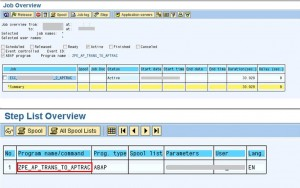
Before going for Background job not listed in transaction SM50. Here and there you might have a foundation work dynamic in your work sign in SM37 which you need to troubleshoot or do some examination at run time. However, shockingly, you probably won’t have the option to see it in Cycle Outline t-code SM50. Let’s get started on background job not listed in transaction SM50.

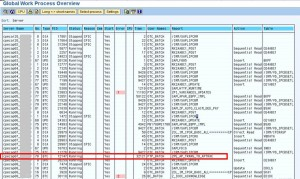
The above work/report isn’t in the SM50 list underneath.

Solution 1:
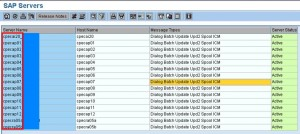
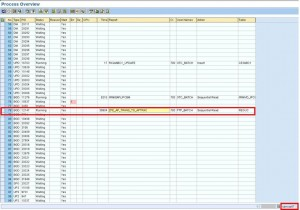
Your scene should have more than one application servers. So you want to investigate different servers other than the server where SM50 is running. Check the above screen shot. The SM50 was running in server 05. The rundown of servers should be visible from t-code SM51.

Check the work which you are chasing after is available in server 07.

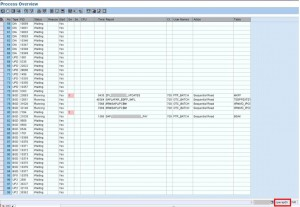
Solution 2: You can likewise see your work in the Worldwide Work Cycle Outline t-code SM66.
Check in the underneath screen, there are occupations from various servers(20/02/04/05/07 and so forth). You can see the positions which was absent in SM50 list.

Tip to debug active job:
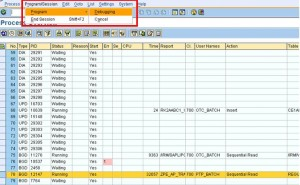
You can investigate the completed foundation occupations planned by your own client id by utilizing order JDBG.

You can investigate the dynamic foundation occupations booked by any client id utilizing t-code SM50/SM51.
Select the work, Program/Meeting >Program->Debugging.
Much thanks for your time!!

YOU MAY LIKE THIS

Automatically Fill Test Data in FM & BAPIs for SE37 – The Lazy Way

SAP ABAP – From Basic to Advanced OData

Objects of Data Dictionary in SAP ABAP

SAP

Transport ABAP Report Variants into a Work Bench Request

A few times it is expected to move the determination variations (made for a report program) starting with one climate then onto the next. We will examine this prerequisite with an example situation. Transport ABAP Report Variants into a Work Bench Request.

Moves toward be followed are: Let’s get started with Transport ABAP Report Variants into a Work Bench Request.

Step 1) Execute exchange SE38 and give the name of the program as:

Step 2) In a similar screen really look at the radio button “Variations” and snap In plain view pushbuttonor follow menu way Goto – > Variations as:

Step 3) In the following screen follow the menu way Utilities – > Transport demand.. as:

Step 4) Execute (F8) the program accordingly shows up in the following screen as:

Step 5) Up on execution a spring up would seem requesting choosing the variations (saved against that report program) to be shipped as:

(We can choose the variations we want and avoid the others)

Stage 6) Up on squeezing Proceed, a next spring up shows up; requesting the vehicle subtleties as:

Here we can pick our own vehicle to move the choice variations for the report program starting with one climate then onto the next.

Trust this data would be helpful to all freshers. 

YOU MAY BE INTERESTED IN

Your Definitive Guide to Becoming a SAP ABAP Developer

Use of data elements in SAP ABAP

Top SAP ABAP Interview Questions (2024)

SAP

SAP ABAP CRM Tips

1: Opening CRM Request in another window (SAP ABAP CRM Tips)

At the point when there is a prerequisite to open a CRM Request (Client Request. Administration Request. and so forth) from a program, the typical interaction is to populate the Business Item Boundary (CRM_OBJECT_ID) with the Exchange Number (OBJECT_ID) and afterward doing a CALL Exchange to CRMD_ORDER. Be that as it may, this technique doesn’t appear to work.

SET Boundary ID ‘CRM_OBJECT_ID’ FIELD .
CALL Exchange ‘CRMD_ORDER’ AND Skirt FIRST SCREEN.

It won’t get into the exchange (CRM Request) , however stop at the inquiry screen.
The strategy for getting around could be utilizing the BAPI BAPI_BUSPROCESSND_DISPLAY to show the CRM Request. You can utilize it to show the CRM Request screen straightforwardly. Simply pass your Request Header GUID ID to the business cycle and the CRMD_ORDER screen will be shown.

CALL FUNCTION 'BAPI_BUSPROCESSND_DISPLAY'
EXPORTING
business_process = <order_header_guid>

2: Embedding or Erasing Standard/Custom messages in CRM GUI.(SAP ABAP CRM Tips)
If conceivable, you can follow the accompanying advances.

a) First delete message, for example
* Deleting the messages from stack

CALL FUNCTION 'CRM_MESSAGES_DELETE'
EXPORTING
iv_caller_name = gc_object_name-order
iv_ref_object = iv_item
it_r_msgidno = lt_idno
EXCEPTIONS
OTHERS = 1.

b) Check for corresponding message text already exists or not, for example

CALLFUNCTION'CRM_TEXT_READ_API'
EXPORTING
it_guid = lt_object_guids
iv_object_kind = gc_object_kind-orderadm_i
IMPORTING
et_text = lt_text.

OR
Search the corresponding messages, for example:

ls_idno-sign = 'I'.
ls_idno-option = 'EQ'.
ls_idno-low-msgid = 'Z_ZZZ_CA_MESSAGES'.
ls_idno-low-msgno = '126'.
APPEND ls_idno TO lt_idno.

CALL FUNCTION 'CRM_MESSAGES_SEARCH'
EXPORTING
it_r_msgidno = lt_idno
iv_ref_object = iv_header_guid
iv_ref_kind = gc_object_kind-orderadm_h
iv_only_errors_on_object = true
IMPORTING
et_msg_info = lt_msg_info
EXCEPTIONS
appl_log_error = 1
error_occurred = 2
OTHERS = 3.

c) If the message does not exist. Then raise message. For example

CALLFUNCTION'CRM_MESSAGE_COLLECT'
EXPORTING
iv_caller_name = gc_object_name-order
iv_ref_object = iv_item
iv_ref_kind = gc_object_kind-orderadm_i
iv_logical_key = 'MAINTAIN'
iv_msgno = lv_msgno
iv_msgid = 'CRM_ORDERADM_I'
iv_msgty = lv_msgty
EXCEPTIONS
not_found = 1
appl_log_error = 2
OTHERS = 3.

YOU MAY LIKE THIS

Conquering the Full Stack Developer Interview: Essential Questions and Expert Tips

Cracking the Code: Your Earning Potential as a SAP ABAP Developer with 5 Years of Experience

SAP ABAP Interview Questions Real time Expectations

SAP

Some Tips

Tips: Here are a few hints which might save some time for you. What’s more, it is consistently fun exploring different avenues regarding the things you know.

Issue: Assume you are separating two numbers (in genuine task situation it is utilized while switching sum starting with one cash over completely then onto the next money) and there is a prerequisite to adjust the outcome.

Simple arrangement: Assume you really want to adjust it to 1 decimal position, utilize a variable having information component having one decimal situation while putting away the outcome. It will be adjusted consequently.

Issue: When you attempt to allocate esteem from character to sum variable or amount variable, it gives short dump.

Simple arrangement: Prior to allocating esteem, dole out any number to the expected sum variable or amount variable. Then, at that point, utilize the dole out the person worth to sum variable. It will take the worth.

Remember it that worth in the person field ought to be in a similar configuration as the variable.

Issue: In Sap script, at some point printing values just in the last page or first page is required. For this we use factors like “SAPSCRIPT-FORMPAGES” or “NEXT-PAGE”. It turns out great yet individuals observe that their content isn’t printing as expected.

For this I have no simple arrangement. You can utilize some text component which is either brought first and foremost or eventually. In any case, I will explain to you the justification for why it doesn’t work. This issue emerges when you attempt to involve these factors in Fundamental window and in principal window these factors don’t work, unfortunately. So even you check your structure and it appears to be legitimately secure, you won’t obtain wanted outcome. It is torment taking to troubleshoot a SAP Content so we don’t really look at it in investigate mode and continue to bang our heads. This tip can be valuable for them. 

I can give you another tip like, if you need to print any line or box something to that effect in the end page just and that must be a piece of fundamental window, then, at that point, I will propose, utilize a pseudo window, over lapping the primary window. You can involve the variable in that window and can use to print something like box or line at the page you want.

At any rate on the off chance that such prerequisite is required, do tell me in the remark segment; will make an honest effort to give you an elective rationale to do as such.

Issue: In Sap script, when we truly do sum computation in sub routine pool program (a z program which is called from the Sap content to do information control), even we use ‘(<)’ administrator to move the negative sign to one side of the sum, it doesn’t work.

Arrangement: This is again one issue which makes designers bang their heads. The issue happens on the grounds that the variable which returns the worth from the Z program is type “scorch”. So order like ‘(<)’ doesn’t work. For this you need to check regardless of whether the worth is negative in the sub routine pool itself and afterward in the event that it negative, you need to eliminate negative sign from the right and need to link short sign in left of the worth.

There are many tips like this which look little yet are exceptionally compelling. Might be in a little while… and if you need to share something, kindly do in the remark segment.

YOU MAY BE INTERESTED IN

Extensive Tips and Tricks for Interactive SAP ALV

Tips for Building Custom SAP Applications: A Comprehensive Guide

Tutorials on SAP ABAP

× How can I help you?