
SAP & Oracle partner and support companies

Loading

Migration Process for SAP Cloud Platform Integration
SAP

Simplifying and Accelerating Your Migration Process for SAP Cloud Platform Integration

LET’S go in depth of Migration Process for SAP Cloud Platform Integration. Because of the developing meaning of the cloud, organizations should rethink existing middleware systems and decide if to change to a cloud incorporation stage. It is guessed that SAP clients will survey the SAP Cloud Incorporation Stage (SAP CPI), a savvy crossover combination arrangement using open-source and cloud-local innovations, as a relocation elective from SAP PI/PO, the favored middleware choice for in excess of 12,500 endeavors across ventures. The benefits of moving to Drain CPI and the potential costs, time responsibilities, and expertise needs connected with a troublesome specialized project are habitually obscure to organizations. Various client mix issues have been settled thanks to Drain S/4 HANA relocation administrations, and arrangements are accessible to mechanize and revive movements.

Migration Process for SAP Cloud Platform Integration

An on-premise middleware framework called SAP PI/PO has vigorous elements, a natural UI, and engineer local area support. Nonetheless, SAP has uncovered a cloud-first item procedure called SAP CPI, which connections SAP applications that are facilitated on-premises and in the cloud with other SAP applications and applications from outer designers. Melding different information and frameworks upgrades reconciliation adequacy, gives coordinated computerized encounters, and advances organization activities. Further developed reconciliation proficiency, business tasks, and computerized encounters are only a couple of benefits of changing from SAP PI/PO to CPI.

1. A Strong Digital Foundation For An Intelligent Enterprise:

As per SAP, organizations speeding up their excursion to an insightful undertaking utilizing SAP S/4HANA Cloud and Ascend with SAP arrangements ought to likewise change to Drain CPI. This is so in light of the fact that all SAP Heave applications utilize SAP CPI as their central coordination innovation.

2. End Of Standard Maintenance Support For SAP Conventional Middleware:

SAP said it will keep on giving standard upkeep backing to Drain PO 7.5 until 2027 yet not so much for SAP PI/PO 7.4 or prior adaptations. Clients currently utilizing SAP PI/PO 7.5 ought to change to Drain CPI since it is more versatile and reasonable than its ancestor.

3. Real-Time Integration:

In contrast to Drain PI/PO, SAP CPI offers devices like SAP Occasion Lattice and SAP Programming interface The executives to work with constant reconciliations across circulated application scenes.

4. Pricing Flexibility:

SAP CPI gives clients different valuing choices to suit their business necessities, including Pay more only as costs arise (PAYG) and Cloud Stage Endeavor Understanding (CPEA). With SAP CPI, in contrast to Drain PI/PO, you can move began immediately with minimal beginning cost and no drawn out monetary responsibilities.

5. Significant Cost Savings:

Since SAP CPI is a cloud-based stage, it is less difficult to screen, work, and execute than SAP PI/PO, which is introduced on-premise. While utilizing SAP CPI, you don’t need to be worried about on-premise middleware’s incessant equipment invigorate cycles or high support recharging costs.

6. Rapid Integration With Prepared Integration Content:

Using the 2600+ pre-fabricated association situations, 2500+ prepared to-utilize APIs, and 200+ connectors in the SAP Programming interface Business Center, SAP CPI empowers you to rapidly and moderately develop cloud-to-endlessly cloud to-on-premise mixes. Since SAP PI/PO needs such prepackaged joining data, it is less helpful than SAP CPI in fast coordination situations.

SAP Cloud Platforms : A Comprehensive Guide

Limitations During The Transition From SAP PI/PO To SAP CPI

  • Because of the absence of great movement computerization advancements, organizations need assistance in guaranteeing a solid and fast exchange from SAP PI/PO to Drain CPI. This makes assessing the important cash and assets for the SAP CPI move project troublesome.
  • Movement to S/4 HANA is a mind boggling process with assessment, arranging, and execution steps. Organizations require specific reconciliation engineers to assess their current circumstance, characterize relocation strategies, and test moved content. Manual execution is expensive and tedious.
  • Specialized relocation intricacy emerges when SAP PI/PO to Drain CPI expects designers to move combination situations, like connectors and message mappings, from SAP PI/PO to Drain CPI. Inconsistent connectors and custom connector modules require upgrade, while planning capabilities like defined values can’t be used.
  • Appropriate testing of SAP administration connection points is urgent prior to progressing from customary middleware to CPI. Utilitarian specialists are frequently utilized, however organizing with different specialized specialists can be difficult and mistake inclined.

Conclusion

Organizations might modernize their joining scene and become more adaptable, innovative, and future-prepared by relocating from conventional SAP middleware to Drain CPI. The outing to relocate SAP CPI will be simpler and additional tedious with a mechanized apparatus.

The post Improving and Speeding up Your Movement Interaction for SAP Cloud Stage Incorporation showed up first on Epnovate.


SAP’s Industry Cloud
SAP

Crafting a Business Strategy Utilizing SAP’s Industry Cloud

An organization’s prosperity is enormously impacted by its accomplices, who continually give clients higher worth because of SAP’s accomplice organization. Presenting the business cloud as a part of the shrewd venture design empowers organizations, accomplices, and Drain to grow start to finish business organizations and cycles with measured cloud answers for their center organizations. A layout of SAP’s industry cloud system and significant thoughts might be seen as here.

SAP Cloud Platforms : A Comprehensive Guide

Key Drivers And Goals Motivating The Industry Cloud Strategy

The insightful suite and industry cloud are based on the groundwork of SAP BTP, which upholds broad business processes inside and outside the partnership. In view of SAP BTP engineering, the business cloud grows SAP applications’ best-practice business abilities with forefront, measured arrangements made by SAP and its accomplices. Key goals and drivers guide the modern cloud procedure.

  • New plans of action and methodology require development, and SAP S/4 HANA industry arrangements offer benefits with incessant organization. Notwithstanding, undertakings much of the time use non-SAP stages, bringing about divided framework design, lopsided client encounters, and a high all out cost of proprietorship (TCO).
  • A design that upholds secluded developments by SAP and accomplices who support associations’ center organizations is expected to add abilities to the applications of the clever suite and the business organization.
  • Environments foster on open stages that give all clients business worth and space for development. The stage that offers the best worth successes. With the assistance of the advanced innovations on SAP BTP, the insightful suite, the business organization, and other essential assets, novel business arrangements can be made.

Connectivity with SAP BTP

SAP’s Industry Cloud Shifting Industry Boundaries

Associations team up across ventures, reexamining esteem chains, providers, and buyers and looking for new advancement potential open doors. SAP’s modern cloud mirrors the requirement for organizations to constantly change their center organizations. These arrangements empower fast reaction to changing business needs, advance activities, and embrace best practices from related enterprises. Industry cloud arrangements incorporate predictable UIs, notable plan examples, and attachment and-play coordination, making them simple to find, buy into, and use. They aid finance, material, production network, and resource the executives.

SAP’s industry cloud empowers endeavors to consolidate dependable E2E processes with problematic development at the upward edge of their current and future plans of action and activities. Business development starts with thoughts, and transforming a thought into a business cycle and arrangement requires a development space with every one of the instruments and assets expected to build and convey in an ideal and unsurprising way. SAP arrangements furnish clients with direct admittance to the smart suite’s business areas and cycles through APIs. Conversely, business and innovation administrations offer the vital apparatuses and foundation to fabricate and keep up with state of the art modern cloud arrangements.

SAP’s Next Generation Service Parts Management

Building A Business Strategy

  1. The Business Cloud Organization Potential open doors With SAP

Vertical arrangements controlled by the business cloud are accessible to each Drain administrations organization. These items are viable with the keen suite and were developed on the SAP Business Innovation Stage. The coordinated go-to-showcase technique empowers accomplices to contribute essentially to Drain’s insightful venture methodology, cultivating manageable development and change that is both reasonable and powerful.

  1. Tending to Our Clients’ Requirements

SAP’s accomplices are vital for advance change benefits and advance development and joint effort. Through specific applications made to satisfy the needs of a specific industry, they can cooperate to help clients in accomplishing practical and feasible development. An open stage for advancement and cooperation, SAP’s industry cloud empowers clients to prevail in a changing climate by creating “next strategic policies” for organizations and organizations.

  1. Keep up with Uniqueness

Business circumstances that are changing rapidly require adaptability and fast transformation. Industry-explicit cloud arrangements from SAP are exceptionally important for organizations, separating them from rivals and working with beneficial extension. To make a fruitful Industry Cloud business, fathom SAP’s system, participate in job based preparing, understand the means and necessities for making Industry Cloud arrangements, and examine Go-To Market open doors with SAP Industry Cloud, access a pre-characterized learning way with Result Based Direction.

  1. Preparing And Advancement

To find SAP Industry Cloud procedure, make and execute state of the art vertical arrangements, and get a SAP Industry Cloud information identification, access learning ventures. Work on how you might interpret the arrangements, give a-list demos, and utilize the assets in the unified demo shop. Analyze and get to deals and presales delicate abilities content to work on your capacities.

End

The establishments, preparing, enablement, and arrangements expected to foster an effective Industry Cloud business are undeniably canvassed in this aide. It subtleties the business network climate, SAP S/4 HANA industry arrangements, and accomplice items important to run the arrangement. Industry cloud arrangements likewise offer data for incorporating, customizing, and designing these items, empowering organizations to conclude whether their answer surroundings are prepared for fitting and-play reception or whether further planning is fundamental. Make an effective Industry Cloud business today.

The post Creating a Business System Using SAP’s Industry Cloud showed up first on Epnovate.

What is SAP mining
SAP

What is SAP mining ?

  1. SAP Mining industry Outline

The modern creation and financial development drives the interest both in homegrown and unfamiliar business sectors. High capital costs associated with the mining business makes it defenseless against contemplate upon the instability. The plunge in the china’s development rate has made the key items like iron mineral and coal to bring down into the over-supply. In spite of having more vulnerable ware costs the public authority is competing for their own pie and cost accelerations adding the more regrettable to it.

Instead of cost decrease and interaction improvement designs the diggers should leave on the economical business climate. They could anticipate completely coordinate the creation and exchanging tasks request to produce rich end worth and better cost controlling.

  1. SAP Mining industry challenges
  • Due huge topographical presence mining organization’s cycle are hampered by non-coordinated and different business frameworks.
  • Issue in combining cycles and diminishing the organization’s worldwide common assistance costs.
  • Framework scene advancement and welcoming every one of the applications on single stage.
  • Representatives confronting difficulties in rapidly sharing and recovering expert data, and capacity to pursue ideal choices, while simultaneously diminishing expenses.
  • Process intricacy in consolidating consolidations or acquisitions.
  • Expansion in Ware Values, Cost expansion , expertise deficiencies
  • Asset nationalization and getting funding

Purpose

SAP Mining upholds mining-explicit cycles and furnishes you with key data that empowers you to maintain your mining business really and productively. SAP Mining coordinates creation, business, and backing cycles to empower undertaking wide preparation, execution, and announcing.

SAP Mining comprises of a few specialized parts. One of these parts IS-Mine. The data in this report covers just the capabilities conveyed with the IS-Mine part. The capabilities and devices conveyed with IS-Mine are intended to deal with the accompanying key business processes in the mining business:

Mining and essential circulation

  • Keep up with and improve all mining processes
  • Gather information on all mining processes

Auxiliary handling

  • Plan long-and momentary creation goals
  • Oversee cost of whole store network
  • Oversee dissemination processes

Integration

The SAP Mining arrangement conveys capabilities intended to cover mining business processes in by coordinating the accompanying:

  • IS-Mine part
  • SAPERPCentralComponent (SAPECC)
  • SAP arrangements, for example, SAP Progressed Organizer and Analyzer (SAPAPO)

As the chart beneath shows, the IS-Mine part requires SAPECC.

Features

The IS-Mine part depends on the IS-Oil part, in this way having similar usefulness with upgrades included where they are expected for the mining business. Subsequently, a similar SAP Library documentation is conveyed for both the part IS-Oil and IS-Mine.

FAQs

  1. How does SAP Mining differ from traditional data mining?
    • It goes beyond traditional data mining by leveraging the capabilities of SAP systems, providing more sophisticated data extraction and analysis within the SAP framework.
  2. What industries have successfully implemented Mining?
    • SAP Mining has found success across various industries, including finance, healthcare, , and retail, showcasing its versatility and applicability.
  3. Is it only suitable for large enterprises, or can small businesses benefit as well?
    • While larger enterprises may have more extensive data sets, SAP Mining can be tailored to suit the needs of small businesses, offering scalable solutions based on their specific requirements.
  4. How long does it take to see tangible results after implementing Mining?
    • The timeline for seeing tangible results from Mining varies based on the complexity of the implementation and the specific goals of the organization, but many businesses observe positive outcomes within a few months.
  5. Are there any specific regulatory considerations for implementing Mining, especially in industries with strict data regulations?
    • Yes, businesses implementing Mining in industries with strict data regulations should ensure compliance with relevant data protection laws and regulations, making it essential to factor in regulatory considerations during the implementation process.

You may be interested in:

SAP Consultant Salary in Pune: Decoding Compensation Trends

SAP Business One: Empowering Small and Medium Enterprises

Understanding SAP HANA

sap implementation process
SAP

sap implementation process

SAP Implementation Process | Phases of ASAP Methodology

SAP ERP smoothes out the majority of the cutting edge business processes, yet a legitimate sap implementation process is significant for the successful work process of the association. Besides, cautious contemplations and key arranging are expected for augmented results post the execution of SAP ERP.

sap implementation process

Quickly technique is a basic piece of the product advancement life cycle for SAP execution projects. The quickly philosophy partitions the SAP execution project into significant stages or achievements that should be accomplished for fruitful SAP execution.

What is ASAP methodology in SAP?

ASAP methodology is basically the strategy by which the framework programming of SAP is executed over the business server, consequently working with work productivity and business activities. The appropriate execution of the ASAP apmethodology proach guarantees work process the executives and assessment as well as deals with the related gamble.

What are the steps of the SAP implementation process?

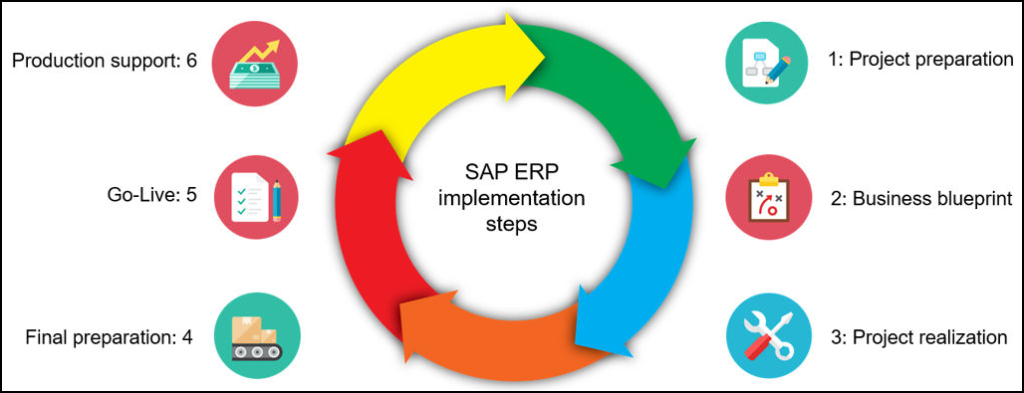
The quickly philosophy proposes sequential strides for fruitful SAP execution. A point by point outline of these means has been given beneath,

Project Preparation

The most important phase in the SAP execution process is project readiness that is, setting up an effective guide, according to the business prerequisites and functionalities.
In this step of the SAP execution process, arranging capabilities are performed, following the different factors and subtleties of the business prerequisites. This stage sets the standard for fruitful SAP execution and requires vital dynamic on specific variables, for example,

  • Defining project goals and objectives
  • Establishing the scope of implementation
  • Arranging the task arrangement, financial arrangement, and execution plan
  • Setting up the venture association and assigning assets

Business Diagram

Following the undertaking planning, the assets are designated based on the standards and prerequisites for the new framework. The mix details, connection point, and interaction maps are laid out from now on.
This step of the SAP execution process includes the presentation of hole investigation which suggests the review and examination of contrasts between two data frameworks or applications to decide the most common way of relocating to the new state.
When the distinctions have been distinguished, considered, and assessed, a business plan is set down. This business outline incorporates the expected business information lined up with the different business objectives and the further targets to be laid out. Consequently, a structure is organized as per the different goals of the business and the ongoing information investigation.

Acknowledgment

When the business outlines have been laid out, standard design is played out, that is to say, arranging the SAP execution rules based on the outcomes got from plans and the business objectives.
The utilitarian specialists complete the arrangement steps in this stage and the handling is finished in this step of the SAP execution process. Followed by arrangement, different testing systems are completed for the smooth working of the business.

Last Readiness

When the acknowledgment has been effectively completed, last arrangements are finished in the SAP execution process. This incorporates testing, preparing, framework the executives, and last cutovers to determine any necessary issues to be settled. Consequently, it is essential to guarantee that every one of the prerequisites of the business are being satisfied in this phase of SAP execution.
Ace information is transferred to the new framework utilizing LSMW, BADI, and BAPI. Then, at that point, the client begins utilizing the SAP framework. End-client preparing is given to individuals working at the client’s end. To put it plainly, the venture goes live.
Different testing strategies are gone through in this stage, for example, responsibility testing, reconciliation testing, and fictitious testing. It is vital to perform support checks in this phase of the SAP execution process for ideal execution.

Go-Live and Support

The last move toward the SAP execution process is going live with the new framework and utilizing this recently carried out SAP framework for the business processes.
In addition, it is likewise guaranteed that the framework is moving along as expected. Here, different help and emotionally supportive networks are given to fix any harms and work with a smooth work process.

How to track down the best Drain MSP?

  1. The decision of a SAP oversaw specialist co-op guarantees the smooth organization, the board, and observing of the SAP ERP arrangement. Examined beneath are the imperatives of a decent SAP MSP for smooth business working,
  2. Specialized Abilities: The right SAP MSP should have satisfactory involvement with SAP execution and handling. They should be furnished with the right specialized abilities and can propose the right approaches, structures, and practices for executing and dealing with the SAP ERP framework.
  3. Decreased costs: The ideal SAP MSP will help with bringing down the expense of tasks so the labor force can zero in on the center business activities. With the right SAP MSP, you get the right arrangement of mastery and administrations to accomplish your business activities, at the right expense.
  4. Improved security: With the right SAP MSP, you move a solid climate to get rid of all the potential digital dangers and security difficulties and appreciate total consistence the board.

You may be interested in:

SAP CPQ – Business Process flow for Back-end Integrations

Future of ERP : The Next Big thing in ERP

How AI and ERP Systems Work Together

What iS SAP Migration ?

SAP in the Cloud
SAP

SAP in the Cloud: Migrating and Optimizing Your ERP System

Introduction to SAP in the Cloud

SAP (Systems, Applications, and Products) has been a cornerstone in enterprise resource planning (ERP) for decades. In recent years, businesses are increasingly recognizing the benefits of migrating their systems to the cloud. This article explores the nuances of SAP in the cloud, delving into the migration process and strategies for optimizing ERP systems.

SAP Integration: Strategies for Seamless Connectivity

Benefits of Cloud Migration for SAP

In the ever-evolving business landscape, companies are seeking ways to enhance efficiency and reduce costs. Migrating SAP to the cloud offers a myriad of advantages, from significant cost savings to improved scalability and flexibility. The cloud provides a robust infrastructure that can adapt to the changing needs of a business, ensuring optimal performance and reliability.

Challenges in Cloud Migration

While the benefits are compelling, the journey to cloud comes with its set of challenges. Data security concerns, integration complexities, and managing change within the organization are among the hurdles businesses face. Addressing these challenges requires a comprehensive strategy and careful planning.

SAP HANA Cloud: A Comprehensive GuidE

Best Practices for Successful Migration

To ensure a smooth transition, businesses must follow best practices. Thorough planning and assessment are crucial, helping organizations identify potential pitfalls and mitigate risks. Choosing the right cloud provider, implementing effective data migration strategies, and rigorous testing and validation processes are key components of successful cloud migration.

Optimizing SAP in the Cloud

Migrating to the cloud is just the beginning. Continuous monitoring and optimization are essential for maximizing the benefits of cloud. Leveraging cloud-native features and implementing automation for routine tasks can further enhance efficiency and streamline operations.

Real-world Success Stories

To provide a practical understanding, this article includes real-world success stories of businesses that have successfully migrated their systems to the cloud. These case studies offer insights into the challenges faced, lessons learned, and the tangible benefits achieved.

Future Trends in Cloud Migration

As technology evolves, so does the landscape of cloud migration. The article explores emerging trends and technologies that are shaping the future of cloud. Businesses need to stay informed to make informed decisions and stay ahead in this dynamic environment.

Common Myths About Cloud Migration

Dispelling myths is crucial for fostering a clear understanding of cloud migration. This section addresses common misconceptions, debunking myths to provide a more accurate portrayal of the benefits and challenges associated with SAP in the cloud.

Steampunk Chronicles: Navigating the Cloud with SAP BTP ABAP Environment

Conclusion

In conclusion, migrating SAP to the cloud is a strategic move that offers significant advantages for businesses. By understanding the challenges, following best practices, and staying informed about emerging trends, organizations can successfully navigate the complexities of cloud migration.

FAQs

  1. What are the primary reasons for migrating SAP to the cloud?
    • The primary reasons include cost savings, scalability, and improved performance.
  2. How can businesses ensure data security during the migration process?
    • Robust planning, encryption, and compliance with security standards are crucial for data security.
  3. Is SAP cloud migration suitable for small businesses?
    • Yes, cloud migration is scalable and can benefit businesses of all sizes.
  4. What role does automation play in optimizing SAP in the cloud?
    • Automation streamlines routine tasks, improving efficiency and reducing manual workload.
  5. How can companies stay updated with the latest trends in cloud migration?
    • Regularly following industry publications, attending conferences, and engaging with cloud service providers are effective ways to stay updated.
SAP Integration
SAP

SAP Integration: Strategies for Seamless Connectivity

I. Introduction to SAP Integration

SAP integration is a critical aspect of modern business operations, enabling seamless connectivity across various systems. Despite its significance, organizations often face challenges in achieving truly integrated workflows. This article explores the strategies and best practices for mastering SAP integration, ensuring smooth connectivity and optimal performance.

II. Understanding SAP Integration

At its core, SAP integration involves the seamless exchange of data between different SAP modules and external systems. The increasing complexity of business processes makes integration a necessity for organizations striving to enhance efficiency and decision-making.

III. Common Integration Challenges

While SAP integration brings numerous benefits, it comes with its set of challenges. Data inconsistency, system compatibility issues, and security concerns are common hurdles that organizations need to address to achieve successful integration.

IV. Strategies for Seamless SAP Integration

Achieving seamless SAP integration requires comprehensive planning, selecting the right integration tools, and implementing effective data mapping and transformation processes. A well-thought-out strategy lays the foundation for successful integration projects.

V. Role of API in SAP Integration

Application Programming Interfaces (APIs) play a crucial role in SAP integration, facilitating communication between different software systems. Understanding the benefits and challenges of API integration is key to leveraging its potential for seamless connectivity.

VI. Real-time vs Batch Integration

Choosing between real-time and batch integration depends on specific business requirements. This section explores the pros and cons of both approaches, helping organizations make informed decisions based on their needs.

VII. Case Studies: Successful Integration Stories

Learning from real-world examples is invaluable. Examining organizations that have mastered integration provides insights into best practices and potential pitfalls to avoid.

VIII. Testing and Validation in Integration

Rigorous testing and validation are essential steps in the integration process. This section emphasizes the importance of thorough testing and outlines best practices for ensuring the reliability of integrated systems.

IX. Scalability and Future-Proofing

As businesses evolve, scalability becomes a crucial consideration in integration. Planning for future growth and staying informed about emerging trends are essential for building a resilient and future-proof integration infrastructure.

X. User Training for Integrated Systems

Even the most advanced integrated systems won’t yield optimal results without user adoption. This section explores the importance of user training programs to ensure that employees can effectively navigate and utilize integrated workflows.

XI. Overcoming Resistance to Change

Resistance to change is a common obstacle in integration projects. Identifying and addressing resistance early on, along with implementing effective change management strategies, is vital for the success of integration initiatives.

XII. Cost Considerations in SAP Integration

While the benefits of integration are significant, organizations need to consider the initial costs and long-term savings. Proper budgeting and understanding the potential for long-term cost reductions contribute to the success of integration projects.

XIII. Monitoring and Maintenance

Integration is an ongoing process that requires continuous monitoring and proactive maintenance. This section explores strategies for monitoring performance and ensuring that integrated systems operate at their best.

XIV. Conclusion

In conclusion, mastering SAP integration is a journey that requires careful planning, the right tools, and ongoing commitment. By addressing common challenges, implementing effective strategies, and staying adaptable to future trends, organizations can achieve seamless connectivity and unlock the full potential of their SAP systems.


FAQs

  1. How long does it typically take to implement SAP integration successfully?
    • The timeline for integration varies depending on the complexity of the project, but on average, it can take several months to a year for successful implementation.
  2. Can SAP integration be achieved without significant disruptions to ongoing business operations?
    • Yes, with proper planning and execution, It can be carried out with minimal disruptions to ongoing business operations.
  3. What role does change management play in integration?
    • Change management is crucial in overcoming resistance to change and ensuring that employees adapt smoothly to new integrated workflows.
  4. Are there any industry-specific challenges in integration?
    • Yes, industries may face unique challenges based on their specific business processes and regulations, requiring customized approaches to integration.
  5. How often should integrated systems be monitored for performance?
    • Continuous monitoring is recommended, but at a minimum, regular checks should be conducted to identify and address performance issues promptly.

You may be interested in:

The Role of SAP Business One Partner

The Evolving Role of SAP Consultant in the Digital Age

SAP CPI Certification: Your Path to Becoming an Integration Expert

SAP Securities Essentials
SAP

SAP Securities Essentials: Protecting Your Business Data

I. Introduction to SAP Securities

SAP Security (Systems, Applications, and Products) is a security technology that protects a company’s data and systems from unauthorized access. SAP Security includes tools, processes, and measures to monitor access rights and user activities. 

CloudFoundation

SAP Security is a combination of three areas: 

  • Platform security
  • Customization protection
  • Segregation of duties

SAP Security includes: 

  • Black box vulnerability analysis
  • Misconfigurations
  • Checking against weak passwords
  • Insecure connections
  • Access control
  • Cryptography
  • User management
  • Data locking
  • Multiple authorization roles

SAP Security ensures that: 

  • Only legitimate users can access the system
  • Users can only perform their designated tasks
  • Data integrity is granted at all times
  • Data is protected against unauthorized access

SAP Security is important for any enterprise running SAP applications. SAP Systems are a type of ERP software used by many businesses across a variety of industries. 

what is securities transaction tax (stt)

II. Understanding SAP Securities

SAP Securities involves a multi-faceted approach, encompassing various components. Understanding these components and identifying vulnerabilities is crucial to maintaining a secure SAP environment. A security breach in SAP systems can have severe consequences, ranging from data leaks to operational disruptions.

SAP Security Interview Questions: A Path to Success

III. Best Practices for SAP Securities

Implementing role-based access control, conducting regular security audits, and employing data encryption are essential best practices for SAP Securities. These measures help restrict unauthorized access, identify vulnerabilities, and safeguard sensitive data.

SAP security is a key part of an organization’s cybersecurity strategy. Some best practices for SAP security include: 

  • User activity monitoring: Monitor user activity and implement user access controls
  • Data encryption: Ensure data is securely stored and encrypted
  • Enhancement packs: Keep up to date on the latest enhancement packs
  • Standard installation: Revert to standard installation
  • Patch management: Apply patch management
  • Application layer SIEM: Apply application layer SIEM

IV. Importance of Regular Updates

Regularly updating SAP systems is a fundamental aspect of security. Patch management is crucial for addressing vulnerabilities and ensuring that the system remains resilient against emerging threats. Staying updated not only enhances security but also improves overall system performance.

V. User Education and Training

Investing in user education and training is as vital as technological safeguards. Users play a pivotal role in maintaining SAP security, and awareness programs contribute to a culture of security within the organization.

VI. Integrating SAP Security with Overall IT Security

Aligning SAP security with broader IT security policies is essential for creating a cohesive and comprehensive security strategy. Consistency across different systems ensures a unified defense against potential threats.

VII. Advanced Threat Protection in SAP

Utilizing advanced security tools is imperative for detecting and mitigating sophisticated threats. Proactive monitoring and timely response mechanisms are essential to staying one step ahead of potential security breaches.

VIII. SAP Security in Cloud Environments

With the increasing adoption of cloud-based solutions, securing SAP in the cloud presents unique challenges. This section explores effective strategies and best practices for ensuring the security of SAP systems in cloud environments.

IX. Case Studies: Lessons Learned

Real-world examples of SAP security breaches provide valuable insights into the consequences and recovery strategies. Analyzing these cases helps organizations learn from past mistakes and enhance their security posture.

X. Regulatory Compliance in SAP Security

Navigating regulatory requirements is a crucial aspect of SAP security. Non-compliance can result in severe consequences for businesses. Understanding and adhering to industry-specific regulations is paramount for safeguarding data.

XI. Future Trends in SAP Security

Exploring emerging technologies in SAP security and anticipating future challenges helps organizations prepare for evolving threats. This section delves into the latest advancements and trends shaping the landscape of SAP security.

XII. The Human Factor in SAP Security

Addressing internal threats and fostering employee accountability are often overlooked aspects of SAP security. This section emphasizes the role of individuals in maintaining a secure environment and encourages a sense of responsibility among employees.

XIII. Conclusion

In conclusion, SAP security is an ongoing and multifaceted endeavor. From understanding the key components to implementing best practices and staying ahead of emerging threats, businesses must prioritize the protection of their SAP systems. Continuous education, integration with broader IT security, and proactive measures are essential for safeguarding business data.


FAQs

  1. How often should SAP systems be audited for security vulnerabilities? Regular security audits should be conducted at least quarterly to identify and address vulnerabilities promptly.
  2. What role does employee training play in SAP security? Employee training is crucial to create awareness and foster a culture of security, reducing the risk of human-related security breaches.
  3. Can SAP security measures be applied to cloud-based environments? Yes, SAP security measures can and should be adapted for cloud-based environments, with additional considerations for the unique challenges posed by the cloud.
  4. Why is regulatory compliance important in SAP security? Regulatory compliance ensures that businesses adhere to industry-specific security standards, reducing the risk of legal consequences and data breaches.
  5. What are the key future trends in SAP security? Future trends in SAP security include the integration of artificial intelligence, machine learning, and advanced analytics for more robust threat detection and prevention.
SAP Fiori Implementation
SAP

Enhancing User Experience: Tips for SAP Fiori Implementation

Introduction to SAP Fiori Implementation

In the ever-evolving landscape of enterprise applications, SAP Fiori has emerged as a game-changer. This article explores the fundamental principles and practical tips for SAP Fiori Implementation to enhance user experience.

SAP Fiori’s design guidelines are built around five core principles: 

  • Role-based: Fits specific needs and adapts to how a business works
  • Adaptive: Adapts to the way a business works
  • Simple: Makes SAP screens simpler and more ergonomic
  • Coherent: Provides an intelligent, consistent, and integrated user experience
  • Delightful: Provides an easier, more intuitive way to run SAP applications

SAP Fiori is used in SAP applications such as: 

  • S/4HANA and C/4HANA suites
  • SAP Analytics Cloud
  • SAP Data Hub
  • SAP Ariba

SAP Fiori provides over 300 role-based applications, including: HR, Manufacturing, Finance. 

SAP Fiori elements is a framework that includes the most commonly used floorplan templates. It’s designed to speed up development by reducing the amount of frontend code needed to build SAP Fiori apps. 

What is SAP Fiori used for?

Significance of User Experience

Understanding the crucial role user experience plays in the success of any application. We delve into why businesses are increasingly prioritizing user-centric design and how it contributes to overall success.

User experience (UX) is important because it aims to fulfill user needs and provide positive experiences. A good UX can: 

  • Set a product apart
  • Increase customer loyalty and retention
  • Build a better customer satisfaction journey
  • Attract and retain more customers
  • Increase revenue

UX design involves a set of actions and methodologies to understand user needs and goals. This research helps to understand why a product is needed and what would be most valuable to users. 

Key Principles of SAP Fiori Design

SAP Fiori is designed using many design principles. The most important ones are that Fiori is role-based, coherent, adaptive, and simple. Utilizing a role-based approach to business applications creates simplicity where you need it most.

Customization for Business Alignment

Recognizing the importance of aligning SAP Fiori with specific business needs. We discuss the customization options available to tailor the user experience according to organizational requirements.

Responsive Design for Multi-Platform Accessibility

In today’s multi-device world, accessibility is paramount. Explore the significance of responsive design in SAP Fiori implementation, ensuring a seamless user experience across various platforms.

Integration with Existing Systems

One of the critical aspects of SAP Fiori implementation is integrating it with existing enterprise systems. We delve into the challenges and strategies for a smooth integration process.

User Training and Adoption Strategies

Even the best-designed systems require user acceptance. Learn about effective training and adoption strategies to ensure a smooth transition and maximize the benefits of SAP Fiori.

Realizing the Benefits: Increased Productivity

Highlighting the tangible benefits businesses can achieve by implementing SAP Fiori. From streamlined processes to increased productivity, discover how SAP Fiori positively impacts organizational efficiency.

Challenges in SAP Fiori Implementation

Acknowledge the common challenges faced during SAP Fiori implementation. Identifying potential roadblocks is the first step in developing effective mitigation strategies.

Overcoming Implementation Challenges

Explore practical solutions and strategies to overcome challenges in SAP Fiori implementation. From technical hurdles to user resistance, discover how businesses can navigate the complexities.

Continuous Improvement and Updates

User expectations evolve, and so should your SAP Fiori implementation. We discuss the importance of continuous improvement and staying updated with the latest features and enhancements.

Measuring User Experience Success

How do you measure the success of SAP Fiori implementation? We explore key metrics and indicators to gauge the impact on user experience and overall business outcomes.

Case Studies: Successful SAP Fiori Implementations

Dive into real-world examples of organizations that have successfully implemented SAP Fiori. Case studies provide insights into best practices and outcomes achieved through effective implementation.

Future Trends in User Experience and SAP Fiori

What does the future hold for user experience and SAP Fiori? Explore emerging trends and technologies that are shaping the future of user-centric design in enterprise applications.

Conclusion

In conclusion, the successful implementation of SAP Fiori is not just a technical endeavor but a strategic move to prioritize user experience. By following these tips and embracing a user-centric approach, businesses can unlock the full potential of SAP Fiori.

FAQs

  1. Is SAP Fiori suitable for small businesses?
    • Yes, SAP Fiori is scalable and can be adapted to the specific needs of small and large businesses alike.
  2. How long does it take to implement SAP Fiori?
    • The duration of implementation varies based on factors such as customization requirements and the complexity of existing systems. A thorough assessment is crucial.
  3. What training resources are available for SAP Fiori users?
    • SAP provides comprehensive training resources, including online courses and documentation, to facilitate user training and adoption.
  4. Can SAP Fiori be integrated with non-SAP systems?
    • Yes, SAP Fiori supports integration with non-SAP systems, allowing businesses to leverage its benefits while maintaining existing infrastructure.
  5. Are there industry-specific templates available in SAP Fiori?
    • SAP Fiori offers industry-specific templates and applications, ensuring relevance and alignment with the unique needs of various sectors.
SAP S/4HANA
SAP

SAP S/4HANA: A Comprehensive Guide for Businesses

Introduction to SAP S/4HANA

SAP S/4HANA is an enterprise resource planning (ERP) software packageIt’s designed to cover all day-to-day processes of an enterprise, such as: 

  • Order-to-cash
  • Procure-to-pay
  • Plan-to-product
  • Request-to-service

SAP S/4HANA was designed to make ERP more modern, faster, and easier to use. It includes a number of advanced technologies, including: AI, Machine learning, IoT, Advanced analytics

The Evolution of SAP S/4HANA

SAP S/4HANA represents the next step in the evolution of SAP ERP solutions. From its inception to the current version, we explore the journey of SAP S/4HANA and how it has redefined ERP standards.

Here are some evolutions of SAP S/4HANA: 

  • Reorganized ERP modulesSAP S/4HANA reorganized the SAP ECC ERP modules into lines of business (LOBs).
  • Large memory and multi-core processorSAP S/4HANA offers massive computing power.
  • Combined processingTransactional and analytical processing (OLTP + OLAP) were combined to improve performance.
  • Agile methodSAP S/4HANA is built on Agile method which confirms continuous improvement.

Key Features and Advantages

Delve into the distinctive features and advantages that set SAP S/4HANA apart from its predecessors. From in-memory computing to advanced analytics, uncover the capabilities that can revolutionize business operations.

  • Real-time analytics
  • Improved user experience
  • Better productivity
  • Reduced IT costs
  • Faster deployment
  • Better supply chain management
  • Enhanced customer experience
  • Improved financial management
  • Scalability

Understanding the Migration Process

Data migration is the process of moving data from one system to another. It can involve: 

  • Moving data from on-premises to the cloud
  • Moving data between different cloud environments
  • Relocating a database to a more secure location
  • Upgrading or merging a database
  • Establishing a new data warehouse

Data migration can cause downtime, which can interrupt data management operations. It’s important to understand the risks and best practices of data migration. 

Cloud migration
Cloud migration is the process of moving data from on-premises to the cloud or between different cloud environments. Gartner predicts that by 2024, the cloud will account for more than 45% of IT spending. 

Challenges and Solutions

While the benefits are substantial, challenges may arise during the navigation process. Identify common hurdles and explore effective solutions to ensure a smooth journey with SAP S/4HANA.

Customization and Integration Tips

One size does not fit all. Uncover tips and strategies for customizing SAP S4HANA to align with specific business needs. Additionally, understand the importance of seamless integration with existing systems.

User Training and Adoption Strategies

Successful navigation requires active participation. Learn about user training and adoption strategies to empower teams and maximize the potential of SAP S4HANA.

Choosing the Right SAP S/4HANA Edition

Navigate through the available editions of SAP S4HANA and discover how to choose the right one for your business. Tailor your selection to align with organizational goals and requirements.

Here’s some information about the two editions: 

  • On-premiseThis edition is suitable for large enterprises with well-established business processes. It offers a full range of features and highly flexible customization. The on-premise edition is licensed with a one-time perpetual license.
  • CloudThis edition is more restricted than on-premise, with fewer configurations and less control and flexibility. It’s better for businesses that need an ERP for general processes and don’t require much customization. The cloud edition is licensed with a recurring subscription.

Cost Implications and ROI

Analyze the cost implications of navigating SAP S4HANA and understand the potential return on investment. Ensure that the benefits outweigh the costs for a sound financial decision.

Expert Recommendations

Benefit from expert recommendations on best practices, implementation strategies, and continuous improvement to maximize the value of SAP S4HANA.

Conclusion

In conclusion, navigating SAP S4HANA is not just a journey; it’s a strategic decision that can reshape the future of your business. Embrace the transformation, overcome challenges, and unlock the full potential of SAP S4HANA for unparalleled success.

FAQs

  1. Is SAP S/4HANA suitable for small businesses?
    • SAP S4HANA caters to businesses of various sizes, offering scalability to meet the needs of small and large enterprises alike.
  2. What security measures does SAP S4HANA employ?
    • SAP S4HANA incorporates robust security measures, including data encryption, role-based access controls, and continuous monitoring.
  3. Can existing data be seamlessly migrated to SAP S4HANA?
    • Yes, SAP provides tools and methodologies for data migration to ensure a smooth transition to S4HANA.
  4. How long does it typically take to migrate to SAP S4HANA?
    • The duration of migration varies based on factors such as the complexity of business processes and the volume of data. A thorough assessment is recommended.
  5. Are there industry-specific modules available in SAP S4HANA?
    • Yes, SAP S4HANA offers industry-specific solutions and modules tailored to the unique requirements of various sectors.

You may be interested in:

Artificial Intelligence for SAP S4HANA and SAP BTP

SAP ERP For Manufacturing Industry

SAP BTP Development

SAP Cloud Identity Provisioning Service
SAP

SAP Cloud Identity Provisioning Service (IPS) – 2 New updates

I. Introduction

A. Brief Overview of SAP Cloud Identity Provisioning Service (IPS)

SAP Cloud IPS stands as a linchpin in SAP’s cloud offerings, providing robust identity provisioning solutions. As businesses transition to cloud-centric models, the importance of a secure and efficient identity provisioning service cannot be overstated.

B. Importance of Regular Updates in Cloud Services

In the dynamic realm of cloud services, regular updates are the lifeblood that ensures not only security but also the integration of cutting-edge features. This article unfolds the narrative of SAP IPS’s latest updates, focusing on the pivotal role they play in fortifying security and enhancing functionalities.

II. Understanding SAP Cloud Identity Provisioning Service

A. Definition and Purpose

Let’s begin by establishing a clear understanding of SAP Cloud IPS. In essence, it is a service dedicated to managing user identities in cloud environments. The primary purpose is to streamline identity-related processes, ensuring a seamless experience for both administrators and end-users.

B. Key Features

Highlighting the Core Features of SAP IPS is crucial for setting the stage. Previous updates and enhancements serve as a foundation for the latest improvements, creating a holistic understanding of the service’s evolution.

III. The Need for Updates

A. Evolving Security Threats

The cybersecurity landscape is ever-shifting, with threats evolving at an unprecedented pace. We explore how SAP IPS addresses these challenges through regular updates, ensuring that security protocols remain robust against emerging threats.

B. User Feedback and Experience

User feedback is invaluable in shaping service enhancements. This section sheds light on how SAP incorporates user feedback to create updates that align with user expectations and improve overall experience.

IV. Overview of the 2 New Updates

A. Update 1: Enhanced Security Protocols

The first of the two updates focuses on enhancing security protocols. We delve into the specifics, exploring multi-factor authentication, upgraded encryption standards, and the integration of threat intelligence.

B. Update 2: Improved Integration Capabilities

The second update revolves around improving integration capabilities. We examine API enhancements, compatibility with external platforms, and the overall impact on workflow efficiency.

New updates from Identity Provisioning Service (IPS) – Product update

Manage transformations history

Identity Provisioning Service

Identity Provisioning Service. You can now deal with the historical backdrop of changes, survey and reestablish them to a past rendition, as well as download a particular one. This way you will never again have to duplicate, save and oversee changed changes in your own file. Beforehand, you had the option to reestablish a change to its underlying state in particular.

Dealing with changes’ set of experiences is currently upheld for Personality Provisioning occupants running on SAP Cloud Character framework. Clients with occupants running on SAP BTP, Neo climate can reset altered changes to their underlying state.

Cloud identity Service

For more data, see:

Resetting Personality Provisioning framework changes reestablishes them to their underlying state.

Transformation Hsitroy


Returning credentials required while changing URL or host 

As of November 27, 2023, at whatever point you update the URL or the host name of а provisioning framework properties, you should return the upsides of the certification properties, like Secret word, ariba.applications.api.key and others. The main special case for this are the qualification properties of frameworks that are made with a network objective.

You may be interested in:

What iS SAP Migration ?

How AI and ERP Systems Work Together

SAP Fiori Full Blog Series


× How can I help you?