


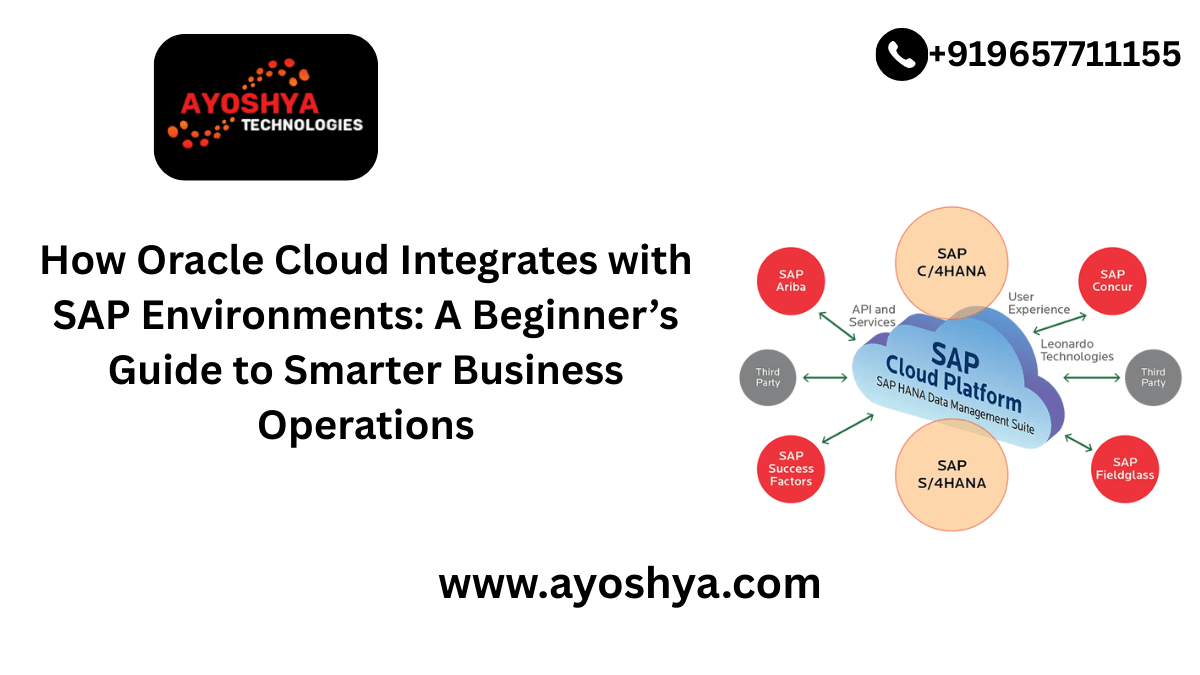
How Oracle Cloud Integrates with SAP Environments: A Beginner’s Guide to Smarter Business Operations
In today’s fast-moving digital economy, businesses are constantly seeking ways to streamline operations, improve agility, and cut costs. One of the most effective ways to achieve this? Integrating powerful enterprise tools like SAP with flexible, scalable platforms like Oracle Cloud.
Whether you’re a business decision-maker, a finance associate, or just someone curious about enterprise IT, understanding how Oracle Cloud integrates with SAP environments is a powerful step toward digital transformation — and financial success for your organization.
Let’s break down the essentials in a conversational and beginner-friendly way.
🌐 What is Oracle Cloud?
Oracle Cloud is a comprehensive suite of cloud services including Infrastructure as a Service (IaaS), Platform as a Service (PaaS), and Software as a Service (SaaS). It’s used by businesses around the world to run workloads, manage databases, and scale applications.
Key benefits of Oracle Cloud:
- High-performance computing
- Cost-effective storage
- Secure, scalable environments
- AI and analytics capabilities
🏢 What is SAP?
SAP (Systems, Applications, and Products in Data Processing) is one of the world’s leading Enterprise Resource Planning (ERP) systems. It’s used to manage everything from supply chain logistics and finance to human resources and customer relationships.
Popular SAP products:
- SAP S/4HANA
- SAP ECC
- SAP Business One
Most large enterprises use SAP as the digital core of their operations.
🔄 Why Integrate Oracle Cloud with SAP?
Here’s the big idea: Businesses that use SAP often face high on-premises infrastructure costs, slow performance, or limited flexibility. Integrating Oracle Cloud with SAP allows organizations to:
- Modernize legacy SAP systems without a full replacement
- Improve performance of SAP applications with scalable cloud infrastructure
- Enhance disaster recovery and security
- Lower TCO (total cost of ownership) by reducing physical infrastructure
In short, you’re unlocking more value from your existing SAP investment.
🚀 How Does the Integration Work?
Oracle Cloud offers certified infrastructure for running SAP workloads, meaning it meets SAP’s strict requirements for performance and compatibility.
There are three major integration approaches:
1. Running SAP on Oracle Cloud Infrastructure (OCI)
SAP applications and databases can be hosted directly on OCI, offering high availability and fast data processing. This is ideal for large-scale operations using SAP S/4HANA.
✅ Tip: Many businesses start with moving non-production SAP systems (like development or testing environments) to OCI before fully migrating.
2. Hybrid Integration
You can run some SAP systems on-premises and others in Oracle Cloud. This hybrid model is great for companies transitioning to the cloud in stages.
✅ Real-world example: A retail company keeps their customer database on-premise for compliance but runs SAP analytics in Oracle Cloud to take advantage of AI tools.
3. Connecting SAP with Oracle Cloud Services
Use Oracle Cloud’s advanced services (e.g., Oracle Autonomous Database, AI/ML tools, or analytics) alongside your SAP environment via APIs and connectors. This enhances your SAP data with smart tools for reporting and decision-making.
✅ Practical tip: Use Oracle Analytics Cloud with SAP to get deep insights into sales trends, employee productivity, or supply chain performance.
📊 Market Trends: Why This Matters Now
Here’s the big picture:
According to Gartner and IDC, over 70% of enterprises using SAP are planning cloud migrations by 2027, and Oracle Cloud is one of the top platforms being considered.
Industry insights:
- SAP support for older systems ends soon (e.g., SAP ECC by 2027), driving cloud transitions.
- Regulatory pressures require better data compliance and security — a strong point of OCI.
- Real-time analytics is a growing need; Oracle’s AI tools can fill that gap for SAP users.
If you’re in a growing business or an industry with heavy data use — retail, finance, logistics — this integration can give you a major competitive edge.
🧩 Common Use Cases of Oracle Cloud + SAP
Let’s make it real. Here’s how companies are using this integration today:
- Finance teams using SAP for core processes and Oracle Cloud for analytics dashboards
- Manufacturers managing production schedules in SAP, while predictive maintenance runs in Oracle’s AI engine
- Retail chains using Oracle’s infrastructure to ensure SAP systems scale during seasonal traffic spikes
💡 Getting Started: Your First Steps
If this sounds complex, don’t worry — you don’t have to dive in all at once. Here’s how beginners (and companies) typically start:
- Assess current SAP infrastructure
- Choose one SAP workload to move or enhance
- Engage cloud experts or IT partners
- Start small — test Oracle Cloud for non-critical SAP systems
- Scale and automate based on success
Oracle also offers preconfigured SAP environments and automation tools to make this easier.
✅ Beginner tip: Use Oracle’s Cloud Calculator to estimate costs before migrating.
🎓 Take the Next Step Toward Digital Mastery
If you’re serious about building cloud literacy, improving your career, or helping your business thrive — now’s the time to level up.
👉 Explore our beginner-to-advanced cloud integration courses, where we break down:
- Cloud architecture basics
- SAP migration strategies
- Real-life case studies
- Hands-on Oracle Cloud labs
With the right knowledge, you can confidently guide your company — or your career — into the future of enterprise tech.
🌟 Conclusion
Oracle Cloud and SAP aren’t just big enterprise buzzwords. Together, they form a powerful engine for smarter, faster, and more resilient business operations. Whether you’re part of a large enterprise or just starting your journey in IT and finance, understanding how these two giants work together is a valuable step toward long-term success.
YOU MAY LIKE THIS
What is AWS Lambda?A Beginner’s Guide to Serverless Computing in 2025
Java vs. Kotlin: Which One Should You Learn for Backend Development?