


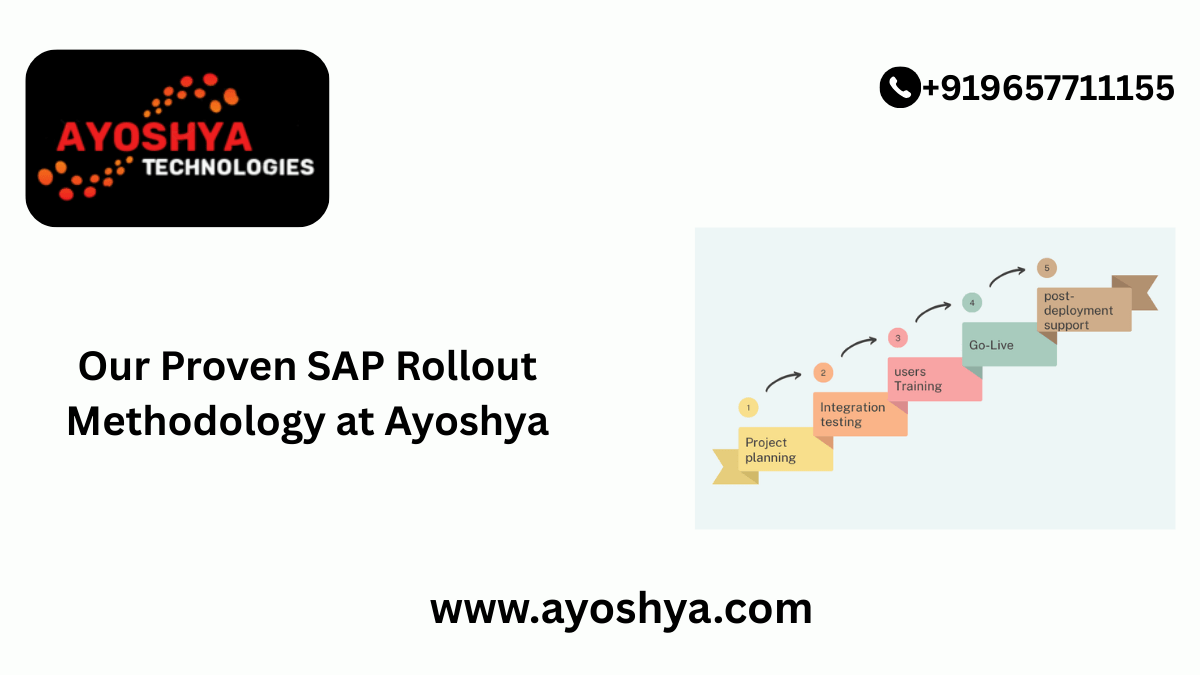
Our Proven SAP Rollout Methodology at Ayoshya: A Beginner’s Guide to Business Transformation
In today’s fast-paced digital economy, businesses are under constant pressure to adapt, scale, and stay competitive. For many organizations, this means turning to powerful enterprise solutions like SAP (Systems, Applications, and Products in Data Processing). But implementing SAP across multiple regions or business units isn’t as simple as flipping a switch — it requires a clear, tested methodology.
At Ayoshya, we’ve developed a proven SAP rollout methodology that not only ensures a smooth transition but also empowers organizations to maximize ROI, streamline operations, and unlock growth. Whether you’re a curious beginner or an employee looking to understand the SAP journey, this guide is for you.
What Is an SAP Rollout?
An SAP rollout refers to the process of deploying SAP software solutions from a central template to new business units, subsidiaries, or countries. Instead of reinventing the wheel for each rollout, organizations use a standardized framework tailored for global operations — and that’s where Ayoshya’s methodology comes into play.
Rollouts can range from implementing SAP in a newly acquired business unit to expanding into global markets with region-specific compliance and localization.
Why Is a Structured Rollout Methodology Important?
Rolling out SAP without a clear roadmap can lead to scope creep, budget overruns, user resistance, and compliance risks. Our structured methodology ensures:
- Consistency across business units
- Scalability for future growth
- Reduced risk of delays or failures
- High user adoption with localized training
- Regulatory compliance in each region
By following a proven process, businesses can implement SAP more efficiently and effectively — with predictable outcomes and measurable benefits.
Ayoshya’s Proven SAP Rollout Methodology: Step-by-Step
Here’s how we do it:
1. Global Template Design
We start with a robust global template that includes best practices, standard business processes, and configurations that serve as the foundation for all future rollouts.
Example: A retail company operating in multiple countries uses a single SAP sales process template but localizes tax rules for each country.
2. Fit-Gap Analysis
Each region or business unit is assessed to identify where local needs deviate from the global template. We perform a Fit-Gap analysis to tailor the solution without compromising standardization.
Tip: Get key local stakeholders involved early to reduce friction and increase adoption.
3. Localization and Legal Compliance
Our team ensures that all regional regulations, such as tax laws, reporting standards, and language requirements, are fully integrated into the SAP system.
4. Data Migration & Testing
Legacy data is migrated into SAP using automated tools. Rigorous testing — including unit, integration, and user acceptance testing (UAT) — guarantees a bug-free go-live.
5. User Training and Change Management
We believe that technology adoption begins with people. Ayoshya provides in-depth user training and change management support tailored to each region’s needs and language.
6. Go-Live and Post-Go-Live Support
We provide 24/7 support during go-live and a post-implementation review to ensure everything runs smoothly. Continuous improvement is key.
Real-World Example: A Multinational Success Story
A global manufacturing company approached Ayoshya to roll out SAP S/4HANA across five continents. Using our methodology:
- We reduced implementation time by 30%.
- The client achieved consistent financial reporting worldwide.
- Local teams reported a 95% satisfaction rate due to customized training.
Industry Insights and Trends: Why SAP Rollouts Are More Critical Than Ever
With digital transformation accelerating across industries, SAP rollouts are no longer just IT projects — they’re business transformation initiatives. Here’s why:
- Cloud-first strategies are pushing companies to adopt SAP S/4HANA and SAP Cloud solutions.
- Remote work and global collaboration demand unified systems.
- Data-driven decision-making relies on centralized, real-time data — a core SAP advantage.
- Compliance is non-negotiable in today’s global regulatory environment.
Practical Tips for Beginners
If you’re new to SAP or enterprise systems, here are some tips to get started:
- Start with the basics: Learn what SAP does and how it’s used in your industry.
- Understand your role: Whether you’re in finance, HR, or logistics, SAP likely has a module that touches your work.
- Join the conversation: Engage with rollout teams, ask questions, and attend training sessions.
- Explore learning resources: Ayoshya offers beginner to advanced SAP courses tailored for professionals like you.
Final Thoughts: Your Journey Begins Here
At Ayoshya, we believe that knowledge is the first step toward transformation. Our proven SAP rollout methodology doesn’t just implement software — it builds a bridge to efficiency, innovation, and long-term success.
Whether you’re a decision-maker planning your next expansion or an employee eager to upskill, there’s never been a better time to dive into the world of SAP.
👉 Explore our SAP learning resources and take the first step toward mastering enterprise transformation.
YOU MAY BE INTERESTED IN
What is AWS Lambda?A Beginner’s Guide to Serverless Computing in 2025
Java vs. Kotlin: Which One Should You Learn for Backend Development?